Showing posts with label terrorism. Show all posts

Tuesday, November 17, 2015

Liberté, Égalité, Fraternité

Deeming the fight between the Western world and ISIS terrorists a "clash of civilizations" distorts what is just a power struggle in the Middle East. Still, as this fight is waged, the West must cling stronger than ever before to its loftier values.


The predictable but nonetheless distressing reaction of many in the aftermath of the heartbreaking weekend Paris terrorist attacks has been to twist the event to fit biased viewpoints. A recurring, deeply erroneous refrain is that the incident represents a clash of civilizations (the West vs. Islam) or a battle of ideologies (freedom vs. terror). This view, undoubtedly appealing to some for drawing ostensibly tidy battle lines, is misleading and dangerous.

The truth of the matter is that the Islamic State (aka ISIS or Daesh), like any geopolitical entity, is motivated by something far simpler: the desire to gain and maintain power. Anything more is a convenient ex post facto justification of actions for a group that bombed Beirut one day before Paris, has killed thousands of Muslims, and is involved in a convoluted civil war against a repressive dictator (Syria's Bashar Assad). Russia's support for Assad is allegedly why Daesh blew up a Russian passenger plane earlier this month.

Friday, December 14, 2012

Smoking Barrels

The U.S. must address its problematic gun culture to stem out-of-control violence.  There is a clear case for implementing stronger controls such as safety training, psychological evaluations, and comprehensive background checks for gun owners.


A gunman killed 27 today at a Connecticut elementary school, most of the victims young children.  This tragedy is the latest in a sad history of high-profile massacres, which have recently included shootings at the Aurora movie theater and Oak Creek Sikh temple.  Gun violence in America is an issue where the numbers are actually even more depressing than the occasional attention-grabbing headlines.  Per the CDC there are more than 11,000 deaths from firearm homicides in the U.S. per year.  Even accounting for our large population, our ratio of firearm-related death rates (9.00 per 100,000 people) is astronomically higher than the rest of the developed world -- more than double neighboring Canada's (4.78), 40 times the United Kingdom's (0.22), and 128 times Japan's (0.07)!

Yet no major national-level political leaders (NYC's billionaire mayor Michael Bloomberg comes closest) have asked Americans to challenge the gun lobby's sick fetish for unfettered gun access, more guns, more powerful guns, and carrying guns in more locations.1  In increasingly vocal terms, the American public is fed up with inaction.  Highlighting the absurd is a post I saw on Facebook: "ONE jackass tries to light his shoe on fire, and every air traveler has to remove their shoes at airport. A gunman, like many before him, shoots up a ton of innocent people and there's nothing that can be done?"  (For all the hype that terrorism gets, keep in mind that in the 10 years after 9/11, only 16 Americans were killed from terrorist attacks in the U.S.)

Friday, October 19, 2012

Stings & The Police

Sting operations by law enforcement have identified individuals who hate America, but using undercover agents to help aid these aspiring terrorists until the point of arrest artificially creates a bigger threat than would otherwise exist.


This week, 21-year-old immigrant college student Quazi Mohammad Nafis was arrested for "allegedly trying to detonate what he thought was a bomb from a hotel room near the Fed in Manhattan's Financial District".  The Nafis case, like the aspiring Portland Christmas bomber, Dallas skyscraper bomber, and others in recent years, involved a would-be terrorist caught by an undercover FBI or NYPD operation, and whose plot was from start to finish created by the law enforcement agency.

My initial reaction, like many Americans, is relief that one of these nutjobs has been stopped before they hurt someone.  But upon further reflection, I've wondered why these "sting" operations seem to always catch a resourceless loner immigrant who has turned radical, but whose every step toward executing an attack is only possible thanks to his handlers.  I worry that these wannabe terrorists have been pushed into committing acts they never had the capacity for -- having previously lacked the knowledge, resources, and connections to carry out a serious attack against America.

Thursday, November 26, 2009

Mumbai, One Year Ago


On this day, the anniversary of the terrorist attacks in Mumbai (Bombay), India, I watched the excellent HBO documentary Terror in Mumbai.  The film pieces together the complete chronology of the 60-hour attack and includes much footage of the terrorists in action as captured by CCTV cameras.  Even more amazingly, the documentary presents much of the dialogue of the terrorists as they were carrying out their murders.

How?  As it turns out, months before the attack, Indian intelligence had planted SIM cards in Pakistan with known terrorist group, Lashkar-e-Taiba, who would be revealed as the masterminds of the attack.  When the attacks began, security officials realized that three of the attackers were using tagged SIM cards, and authorities were able to monitor their conversations in real-time!

Throughout, the terrorists were in contact with their Lashkar handlers, and Terror in Mumbai reveals the chilling details of these conversations.  The terrorists--all young, naive kids--are heartlessly urged to kill as many people as possible, informed that their mission must end in their own deaths (or they won't go to heaven), and fed assurances that God will reward them for their actions.

For me, there was an additional personal reaction to watching the attacks replayed.  My parents, sister, and I were in Mumbai, where my dad's family lives, only a few months before the attacks.  We stayed in the famous Taj Mahal Hotel, perhaps the city's most iconic landmark.  Watching footage of the attackers shoot up the lobby, throw grenades in the tower, and kick down doors to shoot terrified guests is still as surreal now as it was when I was glued to CNN last year watching it all unfold.

Terror in Mumbai, brief though it is (only about an hour long), is a revealing look at many things: the ambitious jihadi aspirations of the Lashkar-e-Taiba, their manipulation of impressionable youth into an ideology of hate and violence, the incompetence of the Mumbai police when the attacks started, the heartbreaking human toll of the attacks (including many Muslim victims), and a damning indication of how groups initally set-up by Pakistani intelligence (ISI) to serve as proxies against India in Kashmir have spiraled out of their handlers' control.

Given how simple it was for this type of terrorist act to be carried out (no hijacking of airliners, just gun-wielding young kids in t-shirts and jeans) it's scary to think how easily such a scenario could be replicated--in India, the U.S., or anywhere in the world.  Fareed Zakaria, who narrated Terror in Mumbai, importantly points out that combating this enemy is about more than just foreign policy or military action.  We also have to fight the conditions of hopelessness that allow our enemies to attract followers to nihilist acts.

The presence of a non-fundamentalist education to teach young people, and a society that provides gainful employment (and thus a viable future instead of a sense of failure) are as instrumental as anything else in the war on terrorism.

Wednesday, June 27, 2007

We're Americans. We Hold Ourselves to a Higher Standard.

Last Sunday, 60 Minutes aired an update to its story on Joe Darby, the Abu Ghraib whistleblower. I hadn't been familiar with Darby's role in the scandal at the infamous prison, and the mortal danger he placed himself in just by doing the right thing.

He and his wife were forced to move from their hometown of Cumberland, MD, to an anonymous location because fellow soldiers, angry neighbors, former friends, and even some of the Darbys' own relatives might seek revenge.

Critics call him a "rat" and "traitor" for supposedly placing the welfare of "the enemy" before U.S. soldiers. They are idiots. What Darby did was place respect for the rule of law first, as it should be according to our country's principles. For those whom that's too abstract an idea, Darby explains his actions in a simple way that makes me really admire and respect him. "We're Americans," he says, "...we hold ourselves to a higher standard."

The idea that the U.S. is special for just that reason, because we expect a higher standard than merely what is convenient, is one that I have always cherished. It's what makes us the "good guys" and separates us from Putin's Russia or communist China. And it's why the U.S., since World War II, has been looked upon as a leader by the rest of the world.


Given the status of the Iraq war and other developments around the world, many people are arguing that the U.S. has lost its preeminent moral standing in the world. Such a claim belies the high esteem the American people are held in throughout most of the world, as well as the positive agendas our government is involved with (for example, democracy promotion, foreign aid, and the Bush admin's commendable effort to fight AIDS and malaria in Africa).

The major blemish currently on our record involves the Bush administration's handling of terrorism suspects outside of a traditional legal framework. At the least, it is burdensome negative PR and phrases like "waterboarding" and "extraordinary rendition" are awkward additions to the American idea of justice. Gitmo's defenders (see also) are somewhat convincing at making a technical argument for the legality of indefinte detainment and military commissions. I doubt that anyone wants to say much about the proliferation of CIA dark sites though. One can only hope that these are relics of a temporary and uncertain era, and the sooner that we can commit them to history's scrap heap, the better.

Which brings me back to Joe Darby's idea of the United States. We're not perfect. We did have slavery, Jim Crow, the internment of Japanese-Americans during WWII, and other problems that persist today. But while America in practice has its blemishes, I'm proud that over the long run we always seem to be moving more toward America the ideal, a place where we set higher standards and serve as a great example of human potential.

Sunday, July 09, 2006

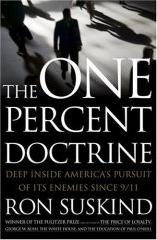
Review: The One Percent Doctrine

This past week I read Ron Suskind's best-selling new book The One Percent Doctrine: Deep Inside America's Pursuit of Its Enemies Since 9/11. Going in, I wasn't sure what to expect from the author of the first major book criticizing President Bush (2002's The Price of Loyalty, about then-Treasury secretary Paul O'Neill, which I have not read). Yet the subject matter was compelling enough for me to pick up the book. Now that I have finished reading it, I can say that this book is important enough to be required reading for all Americans who want to understand the nature of the post-9/11 threat this country faces and how we are responding.

The titular "one percent doctrine" is a reference to a quote by Vice President Cheney, in which he opines that catastrophic threats to the U.S. pose such a great danger that our country's response must be to react those threats with a 1% chance of occuring as being a certainty. Hence, it follows, preemption, unilateralism, renditions, etc.

Probably the first question many people have regarding this book: is it a partisan hatchet-job? The answer is no, and I admit being a little surprised myself here. Suskind's reporting of America's struggle to combat al-Qaeda in the pre-Iraq War years should earn him a medal. He provides an unsurpassed amount of detail into all the successes and setbacks of various U.S. counterterrorism operations.

Some parts of the book seem like Hollywood thriller material. My favorite story involved a CIA operation targeting "al-Qaeda's banker", Pacha Wazir. Afer quietly arresting Wazir and his associates, the CIA sent a few of its specially trained agents of Pakistani descent for an amazing undercover mission. Passing themselves off as distant cousins of Wazir, and explaining the latter's absence due to a family illness, the undercover agents took over Wazir's bank and continued to receive customers. This fantastic operation resulted in the capture of dozens of key terrorists.

Yet tempering triumphs like those are maddening passages like the one detailing how the U.S. bungled the apprehension of the eventual architect of the British 7/7/05 bombings due to bureaucratic tanglings. Another troubling story concerns the capture of Abu Zubaydah, originally thought to be a major al-Qaeda leader and whose apprehension was hailed by President Bush. Problem was, Zubaydah was soon found to be just a menial agent, and worse, a certifiable schizophrenic. Suskind writes that despite this, "the United States would torture a mentally disurbed man and then leap, screaming, at every word he uttered." Zubaydah would conjure up several plot details about attacks on shopping malls, supermarkets, and banks, leading law enforcement to squander valuable resources. Even so, it must be pointed out that in what is perhaps a victory for advocates of "rough" treatment of detainees, Zubaydah finally told his interregators about Jose Padilla.

If there is any story arc to The One Percent Doctrine, it is that Suskind finds former CIA director George Tenet to be a tragic hero--he describes Tenet as being "the man most responsible, if anyone is, that America has not, again, been attacked" and laments how Tenet became the "fall guy" for the Bush administration over the lack of WMDs in Iraq. Suskind is a huge critic of the Iraq war, and toward the end of the book he takes leave of just-the-facts reporting to slam the White House (and then-National Security adviser Condi Rice especially) for the way they handled the runup to the war.

Considering that this book contains terrific reporting about so many things the American public doesn't know about the war on terrorism, I was a bit disappointed to see Suskind's personal viewpoint start to weigh heavier later in the book. Nonetheless, I stand by what I said before, that the book does not come across as overtly biased. There is definitely enough here for any open-minded reader to see both sides and come to their own conclusions.

My only other complaint about this book, one I made frequently though it is minor, is Suskind's penchant for "florid" writing. I think his terse and gripping account of terrorist plots or key Cabinet meetings would have been better off, from the reader's point of view, without being constantly interrupted by sentences like these "The connected planet creates all manner of loops, where knowledge spurs action, which is captured in image and word and then cycled back--the mythical perpetual motion machine comes to life."

Considering the insignificance of the criticisms I have mentioned, I would strongly recommend this book. Besides getting a front-row seat in the bleachers down at Gitmo Bay, I can't think of a way to feel more "in the know" about the war on terrorism than to read The One Percent Doctrine.


Sunday, September 11, 2005

What They Don't Understand

Today, on the fourth anniversary of the September 11, 2001 terrorist attacks, I came back to a column written by Thomas Friedman a few weeks after the Twin Towers fell. The following excerpt contains the simplest and best statement of what makes America great, our flaws notwithstanding, and why the ideology of terrorism does not offer a viable future for the frustrated Muslim masses:

[The Islamic terrorists'] constant refrain is that America is a country with wealth and power but "no values." The Islamic terrorists think our wealth and power is unrelated to anything in the soul of this country -- that we are basically a godless nation, indeed the enemies of God. And if you are an enemy of God you deserve to die. These terrorists believe that wealth and power can be achieved only by giving up your values, because they look at places such as Saudi Arabia and see that many of the wealthy and powerful there lead lives disconnected from their faith.

Of course, what this view of America completely misses is that American power and wealth flow directly from a deep spiritual source -- a spirit of respect for the individual, a spirit of tolerance for differences of faith or politics, a respect for freedom of thought as the necessary foundation for all creativity and a spirit of unity that encompasses all kinds of differences. Only a society with a deep spiritual energy, that welcomes immigrants and worships freedom, could constantly renew itself and its sources of power and wealth.

Which is why the terrorists can hijack Boeing planes, but in the spiritless, monolithic societies they want to build, they could never produce them. The terrorists can exploit the U.S.- made Internet, but in their suffocated world of one God, one truth, one way, one leader, they could never invent it.

Lord knows, ours is hardly a perfect country. Many times we have deviated from the American spirit or applied it selfishly. But it is because we come back to this spirit more times than not, in more communities than not, that our country remains both strong and renewable.

America has made many missteps in the Middle East, and even today, our policies need to be revamped for both our benefit and for the benefit of their masses. Nonetheless, the Muslim public needs to vocally reject terrorism and not sympathize with Osama bin Laden & Co. Terrorism does not offer any constructive message or vision for the future. Terrorism, and continued blind hatred of America and Israel, is not an answer for the Arab countries. Terrorism is not going to solve chronic unemployment or enable political opposition or modernize economies. Terrorism delegitimizes the valid grievances that Muslims have.

Today, on the anniversary of one of the most horrific days in America's history, the fight against terrorism goes on. That fight is interminably connected with the struggle by the Islamic world to offer a better future for its people.

Saturday, July 09, 2005

Future of Terrorism Determined by Muslims

We're all very aware that a sizable portion of the Muslim world does not like the West and what it stands for. Even so, the vast majority of the Muslim world is moderate and sensible. They reject the extremism of the terrorists who act out in barbaric ways that subvert the values of an entire culture. Unfortunately, terrorists continue to believe they have the moral authority to act on behalf of their people. This is because, for the most part, their people are not being emphatic enough in their rejection of terrorism.

The sight of an angry mob in a Middle East country burning an American flag is commonplace. Compare that to the number of times you see a mass demonstration of people in a Muslim county voicing their disapproval of al-Qaeda in such stringent terms--never! This unwillingness on the part of the Muslim world to "police their own" has been disastrous. Writing in Friday's New York Times on the day after the London bombings, Thomas Friedman says that this has got to change. "If it's a Muslim problem, it needs a Muslim solution", he warns, or else the alternative is an irreversible schism between the Western and Muslim worlds.

It doesn't have to be this way. But it will certainly continue to be this way unless the mainstream Muslim world becomes more vocal in its denunciation of those who would hijack Islam. The twisted ideology that fuels terrorism cannot survive once the environment it breeds in turns inhospitable. It is only then can our current "war on terrorism" truly be won.

Thursday, July 07, 2005

Google Earth: Bent on World Observation

For the past couple days, I've been playing around with Google Earth, the latest cool new toy offered by everybody's favorite tech wizards. Google Earth, a descendant of the Keyhole service, allows users to view satellite imagery of any part of the world. This feature, which has been around for many years, has now been integrated with data (where available) plotting transit systems, commercial enterprises, and more. A map overlay detailing schools, restaurants, hotels, and more yields extra information than just the standard terrain scan.

Google Earth is remarkably easy to use. Type in the location you're searching for, and the program automatically "flies" you to your destination in fine cinematic style. I did the requisite searches for famous landmarks (see examples), old neighborhoods, etc., and found the results (when data was available for the location) to be pleasing--if not practical, at least entertaining. Google Earth also tries to incorporate a three-dimensional aspect to the program, allowing users to "tilt" the landscape. While a cool idea, this feature rarely delivers results that look good without losing perspective or detail.

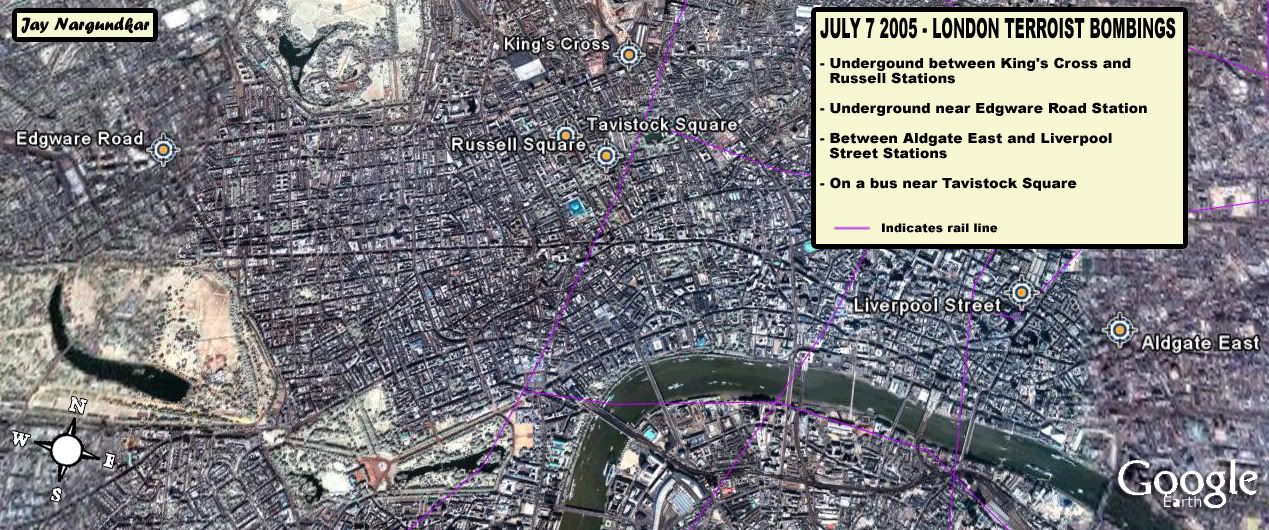
This morning, as I was following the details of the terrible tragedy in London, I decided to put Google Earth to the test to try and create a rudimentary map plotting the locations of the bombings. This proved to be remarkably easy; all I had to was type in the name of a location, say, "King's Cross Station, London", and I was "flown" immediately to the spot. By selecting or deselecting various options, I could view street names, transit stations, rail lines, and more. The resulting map I created is seen below:

Map of July 7 2005 London terrorist attacks.  Click to enlarge.

With regards to today's terrorist attacks, I think British PM Tony Blair said everything that needed to be said:
When they try to intimidate us, we will not be intimidated. When they seek to change our country or our way of life by these methods, we will not be changed. When they try to divide our people or weaken our resolve, we will not be divided and our resolve will hold firm. We will show, by our spirit and dignity, and by our quiet but true strength that there is in the British people, that our values will long outlast theirs. The purpose of terrorism is just that, it is to terrorise people, and we will not be terrorised.

I would like once again to express my sympathy and my sorrow to those families who will be grieving, so unexpectedly and tragically, tonight. This is a very sad day for the British people, but we will hold true to the British way of life.

Today is another reminder that the "war on terrorism" doesn't just take place in faraway countries. Despite all the precautions and security measures in place, our enemies can still on occasion take the war to our doorstep, with devastating results. We are reminded there is still much work ahead of us in order to ascertain a safer, more secure future.

Monday, March 21, 2005

Terrorists' American Arsenal

A couple of high-profile news reports this month should have the Bush administration realizing that the fight against terrorism must be waged on the homefront as well. Two weeks ago the New York Times reported on a Congressional investigation which found that many suspected terrorists on federal watch lists were legally able to buy firearms in this country. Apparently, the lax gun laws in this country don't automatically prevent someone on one of those watch lists from purchasing a gun. Whose idea of homeland security is this?

Sunday's 60 Minutes feature story on gunrunner Florin Krasniqi further underscored how vulnerable our gun laws are to abuse. Krasniqi, who came into the country as an illegal immigrant, spent years smuggling .50-caliber rifles out of the country for use in his homeland of Albania. And he did it all with ease. Says Krasniqi, "Anything you need to run a small guerrilla army, you can buy here in America. You have all the guns you need here to fight a war. M-16s. That's what the U.S. soldiers carry in Iraq. All the rifles which U.S. soldiers use in every war, you can buy them in a gun store or a gun show."

Weapons that terrorists can use to kill lots of people are readily available to them here, and instead of preventing this from happening, we seem to be encouraging it. The NY Times article mentioned the "absurd policy" currently in place which destroys records of a terrorism suspect's gun purchase after 24 hours. Sen. Frank Lautenberg (D-NJ) has the right idea in wanting to store those records for at least ten years. If Republicans are serious about the war on terrorism, they will know to abandon their allegiance to the NRA on this issue and stop defending the "privacy rights" of terrorism suspects with regards to gun purchases. This is not a privacy issue, this is a national security issue.

I'd like to take it one step further. It seems to me that, after we've seen this huge problem exposed, the only proper course of action to take is to ban suspected terrorists from purchasing guns altogether. The loose restrictions we already have in place at least prevent felons from buying guns. Surely lawmakers on Capitol Hill can see the wisdom in denying sworn enemies of our country the means by which to harm us.

Tuesday, February 01, 2005

Submission (to Fear)

Last November, Dutch filmmaker Theo van Gogh was murdered by an Islamic extremist angry at Van Gogh's treatment of Islam in his latest film. That film, titled Submission, was highly critical of the treatment of women in many Muslim societies. With the shocking killing making news around the world, the Netherlands was forced to take a hard introspective look at its society and confront a growing cultural schism.

Instead of coming up with any helpful solutions, it appears that "Dutchland" is dissolving into a culture of fear. Submission was scheduled to be the highlight of the Rotterdam Film Festival this weekend. Until now that is. Citing security concerns, the organizers of the show have now declined to air the Van Gogh film. Not exactly the most inspiring statement of commitment to the principles of freedom of expression, huh? Meanwhile the Muslim writer of Submission, who happens to be a member of Parliament, is living under a heavy security detail.

Those who would promote a climate of apprehension can only be emboldened by the emasculated status of their adversaries. Even more alarming is the attitude of some of those who are fighting back. In today's Washington Post there was a profile of Geert Wilders, a popular Dutch politician with an "aggressively anti-Islamic" agenda. "Islam and democracy are fully incompatible," he proclaims. "They will never be compatible -- not today, and not in a million years."

Wilders' opinion about the idea of Islam coexisting in a free society seem to coincide perfectly with, ironically enough, sentiments recently expressed by the terrorist Abu Musab al-Zarqawi. Humor aside, the very fact that Wilders' extremist views are somehow finding support is troublesome and is indicative of the severity of the crisis in the Netherlands. Many of the affluent countries of Europe are having to deal with the societal upheaval caused by an influx of Muslim immigrants into their community. They have not always found it easy to deal with. One incident that comes to mind is the French ban on the wearing of Muslim headscarves (and other religious icons or symbols) in public schools.

But the worst of it may be in the Netherlands, where the entire concept of multiculturalism seems to be in decay. It's a sign of the dissatisfaction of the times that people like Geert Wilders can effectively channel public anger into popular support. But really, Wilders and his kind are also extremists on end of an ideological spectrum. Like the terrorists they despise, they too are contributing to the hostile atmosphere that poisons a free society.

Says Wilders, "We are in an undeclared war. These people are motivated by one thing: to kill everything that we stand for." Yes, Mr. Wilders, there is an undeclared war taking place right now in your country and across much of Europe. But it is not an ethnic conflict with "these people", as you might think, but rather a fight to maintain respect for freedom and tolerance of all people and all ideas in an era when those values are under assault.