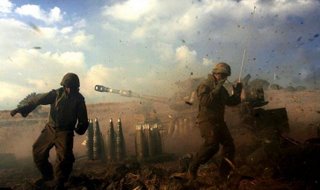
How quickly things change. It was only a year ago that Ariel Sharon was making a historic pullout from the Gaza Strip and it appeared to me that a future peace in the Israel-Palestine conflict was at least not an impossibility. Now, the Middle East is engaged in its worst crisis since the Israeli invasion of Lebanon a quarter-century ago. Just last month I was reading From Beirut to Jerusalem, a history of that conflict--now its deja vu on the front pages.
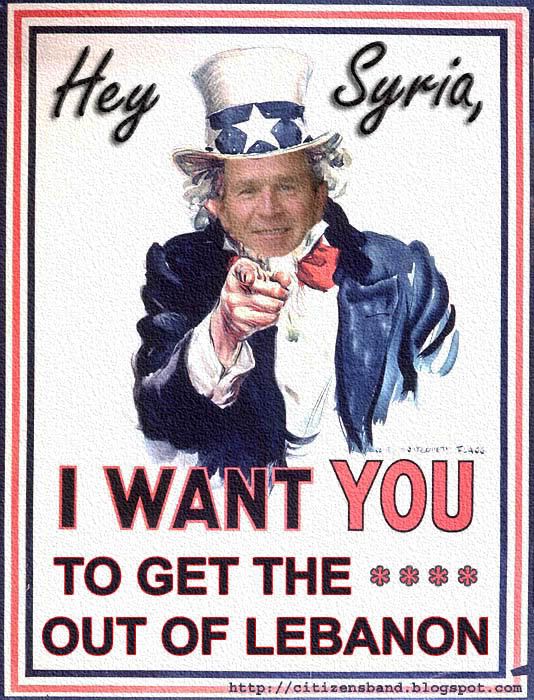
Surprisingly, many people are blaming Israel for this latest flareup, an accusation I believe is unfounded. I think the U.S. position that Israel has the right to stop terrorist attacks (while not using disproportionate force) is a correct one. The current situation is different from those in the past, when I would generally take a more moderate tone with regards to the players. This time the instigator of troubles is very clear--Iran is fully culpable for fomenting instability in the region. This comes after Israel has shown good faith with its unilateral withdrawal from Gaza. This comes after Syria ended a decades-long occupation of Lebanon, giving that country its first chance for democracy and freedom to succeed.
But those signs of progress were too much to stomach for Iran and Syria, of course. Hence their war by proxy against Israel through the extremist groups Hezbollah (in Lebanon) and Hamas (in Palestine). Hezbollah, operating as an autonomous entity in Lebanon, makes a mockery of the institution of self-government in that country, and its actions bring suffering upon the Lebanese people. Likewise with Hamas, who lets it militant wing run unchecked while it neglects the basic operations of running a government.
Robin Wright writes in today's Washington Post that, according to U.S. estimates, Hezbollah receives "$100 million annually from Iran in goods, cash, and arms, including an estimated 13,000 rockets and missiles." That malevolent sponsor also happens to be closing in on attaining a nuclear bomb. Faced with enemies with capabilities like that, I echo David Brooks' incredulity that people think Israel is "overreacting." Israel should sit still and do nothing all this while? Of course not. And let's not act like the U.S. can't pick a horse to back here. The Islamist groups and their state sponsors hate the West and are impediments to the spread of freedom and democracy. Israel's actions against its enemies are in line with U.S. interests.
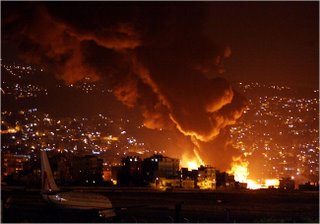
Yet it is important to remember the many, many innocent Lebanese and Palestinian civilians who are victims of this war. What is sad is that they are paying the price for the terrorists that operate from their land. These terrorists know full well the consequences their actions will have on their innocent countrymen, but that doesn't matter to them--only jihad does. Their destructive behavior dooms the people on whose behalf they claim to be fighting.
In this conflict, there is much suffering on both sides. When I see pictures of bombed out buildings and bridges in Beirut, I feel terrible, as I do when I see rockets landing in Haifa. That doesn't change the fact, however, that there is a clear right and wrong. Israel has the right and responsibility to protect its citizens by targeting its enemies. Those enemies aren't just Israel's enemies, they are the enemies of progress and a peaceful future in the Middle East, and everyone would be better off without them.
Is it possible that we can achieve that? Yes, but not with missiles and artillery shells. David Ignatius wrote in Friday's Post about the basic steps needed for a proper resolution to this mess. First of all, this conflict must not be the U.S. and Israel versus the Muslim world, because we are trying to bring the silent majority of moderate Muslims to confront the extremists in charge. The weak central governments that are being eclipsed by the non-state actors must be strengthened: a strong and responsive Palestinian Authority must exist so that it is not hostage to the Hamas militia, and an already pro-Western Lebanese government led by Fouad Siniora must be helped so that it can rein in Hezbollah.
The U.S. should provide assistance in this endeavor, because we--the U.S., Israel, and the Lebanese and Palestinian people--share a common enemy: the extremists. Once they are defeated, then we can look forward to a more hopeful future in the Middle East


 Just over an hour ago, Saddam Hussein was executed by hanging for crimes against humanity. Now that the former tyrant is no more, both the U.S. and Iraq will have to see whether delivering justice to Saddam becomes a milestone toward national reconciliation or serves to further alienate Sunnis (his sect) from the Shiite/Kurd-led government.