Showing posts with label health. Show all posts

Thursday, February 13, 2014

21st Century Snake Oil

In a backlash against technological advancement, numerous anti-scientific beliefs are enjoying a surge in popularity -- even among the wealthier and better-educated segments of the populace.


Recently, I was chided by a couple of good friends for my response to their posting on Facebook a viral video purporting to show popcorn kernels popping when several ringing phones were placed next to the kernels. I was the "spoilsport" who pointed out the video was fake, and that were such a feat possible, the implications would be far more severe and noticeable. Extensive studies have proven cell phones do not cause any health problems, but vague fears of the effects of cell phone radiation (like a previous generation had for microwaves) abound in the popular imagination.1

I have noticed, too, that the similarly-aged friends and acquaintances I know who pay attention to horoscopes, visit psychics, or believe in other supernatural ideas often do not accord much or any importance to the most mainstream supernatural belief: religion. Americans, especially young Americans, are less tied to religion than ever before -- nearly a third of people under age 34 do not claim a religious identification.2 Could it be that these alternate beliefs are filing a vacuum of order in people's lives in the absence of religion? A report this week released by the National Science Foundation revealed that belief in astrology is on the rise, and that younger Americans are fueling this trend.

Beyond just supernatural ideas, anti-scientific beliefs, i.e. magical or non-rational concepts, are enjoying a high profile lately. They are driven by anything from yuppie fads (e.g. an obsession with "super" foods and alternative medicine) to superstitious celebrities (e.g. "energy" necklaces en vogue with athletes).

Saturday, October 06, 2012

Secretary of Explaining Things

The first presidential debate between Messrs. Romney and Obama affected the media's election narrative but did little to provide the average voter with a substantive understanding of key issues.


The widespread and bipartisan media consensus is that Mitt Romney won Wednesday's first presidential debate.  A somnolent President Obama spent most of his time on stage looking down at his podium, handing an easy victory on appearances to the guy who dissed Big Bird. What was reinforced to me, though, is that these debates -- barring the emergence of a popular caricature of one of the candidates -- are aimed at influencing the media's election narrative, not at voters.

These debates are supposed to elucidate a candidate's positions and to help voters distinguish between their choices.  But in practice, we're not given much to work with.  The candidates present what seem like "Mad Libs", random numbers without context or explanation ("4 million jobs" from energy independence; "2 million more slots in our community colleges"; a "$5 trillion tax cut"; "$2 trillion in additional military spending"; a "$4 trillion deficit reduction plan").  The result is empty speechifying, not debating.  And in a generally polite encounter without memorable "zingers" from either man, my eyes were glazing over.

Monday, March 26, 2007

Meat, By Definition, is Murder (But I'm OK With That)

Recently, famed chef and restaurant owner Wolfgang Puck attracted attention when he announced that his businesses were switching to the use of organic ingredients and meat from more humanely treated animals. He was commended by the NY Times for setting an example that reminded consumers of the "power of the choices they make," and for promoting the idea that "they can eat well and do right all at the same time."
This whole issue over treatment of animals that are soon-to-be-food is one I've always been a little confused about. For obvious reasons, we don't like bad conditions in slaughterhouses. Cruelty toward animals is a behavior that goes against our nature, and I hate it as much as the next guy.

Even taking that into account, most of us wind up rationalizing meat-eating along the lines of (1) it's natural for us to eat meat, (2) meat is tasty--very tasty, I might add, and (3) there are health benefits to eating meat--even if vegetarians can receive those same benefits through their diet and/or with multivitamins.

Whatever, to each their own. (Personally, if I was stranded on a desert island, the only two things I'd really want are a George Foreman Grill and a crate of bacon. My third wish would probably be for Reese Witherspoon.) But how exactly do Mr. Puck's actions, and campaigns like the free-range movement, have any effect on easing people's consciences? The farmer gives the chicken a couple more feet to run around, and all of a sudden you can eat well and sleep easy?

Whether cooped up in a cage or allowed to roam, whether fed too little or too much or just right, all of those animals are being raised for the express purpose of being killed for human consumption. Meat eaters have to come to terms with the fact that the basic moral argument aginst eating meat isn't resolved by treating dinner a little better before it's cooked.

Meat, by definition, is murder. Then again, I'm OK with that, and it's perfectly fine if you feel the same way.

Update - Thank you Neha, Andrew, and Greg for your insightful comments. After reading what you wrote, and thinking about the issue some more, I have become convinced that the killing of animals and the treatment of livestock are separate ethical issues. While I remain unopposed to the former as a biologically natural process (eating animals for the purpose of food), I now concur with the commenters' view that the humane treatment of animals raised for the slaughter is in fact a worthwhile goal.

Thursday, May 04, 2006

So Long to Sodas in Schools

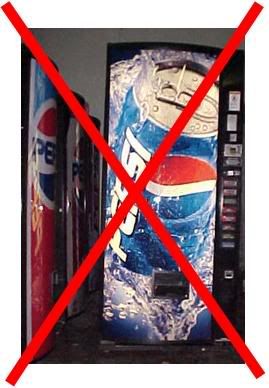
You won't see these in schools anymore.During my Wednesday morning commute, I came across this most unlikely headline in the Washington Post: "Sugary Drinks to be Pulled from Schools". The announcement that soda companies like Coca Cola, Pepsi, and Cadbury Schweppes are pulling their unhealthy wares from elementary, middle, and high schools was a huge surprise to me. After all, I recall that my high school had an exclusive contract with Pepsi. Our school was stocked with Pepsi vending machines and the scoreboard on the football field had a big Pepsi billboard. And the soda companies, which were raking in tons of money, didn't seem to be in a position where they needed to compromise.

(Interestingly enough, the University of Maryland also has a contract with Pepsi which prevents rival Coca Cola products from being sold in the diners. My roommate helpfully informs me that the McDonalds in our student union is one of only two locations worldwide to serve Pepsi products instead of Coca Cola, the fast-food chain's traditonal partner.)

Anyway, so the terms of this voluntary agreement appear pretty stringent:

The agreement calls for eliminating sales of sodas, diet sodas, sports drinks, juice drinks, apple juice or grape juice in elementary schools. Water and more healthful juices such as orange juice could continue to be sold, but in only eight-ounce or smaller containers, according to sources who were briefed yesterday. They spoke on condition of anonymity because the plan had not yet been announced.

In middle schools, the same drinks will be offered but in containers as large as 10 ounces.

In high schools, the drink size will be limited to 12 ounces. No sugary sodas will be sold, and half the drinks offered will be water or a low-calorie beverage, such as diet soda, diet lemonade or diet iced tea. Sports drinks will be allowed, as will juice drinks as long as they have fewer than 100 calories per serving.

It's about time. I remember seeing far too many kids in high school who needed a Mountain Dew just to get through the morning. These days, those kinds of unhealthy dietary habits are starting at an even younger age--just look at the childhood obesity rates. I wish that these sorts of measures were unnecessary, and that children were smarter about their eating decisions. But it's clear that at school and away from their parents, many kids just don't know how to make the right decisions.

I applaud this move by the beverage industry. Of course, the impact on their profits is negligible, they don't have to worry about brand recognition, and these companies can now push their juice and sports drink lines. They don't really have anything to lose. Now we'll have to see how kids react when they can't wash down their lunchtime feast of powdered donuts with a Code Red.