Thursday, July 27, 2006

Sick of Fantasy Football

This post was imported from my group sports blog, "Da Sports Authority."

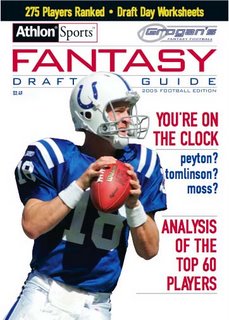
This is going to sound sacrilegious, but take it from an "old timer": this country suffers from a serious Fantasy Football overload. How widespread is the epidemic? The USA Today reports "An estimated nine million Americans will play fantasy football this season...[and] will generate a $3 billion to $4 billion economic impact across the sports industry." (Emphasis added.) You know it's that time of the year when the sports magazine covers have headlines like Fantasy Preview and columnists are already weighing in on Fantasy Draft Day dilemmas.

Trouble is, that time of year seems to come earlier and earlier each year. Keep in mind that NFL teams are just opening training camp and that the start of the season is exactly six weeks away. Depth chart battles and preseason injuries are just getting started. Meanwhile, the fantasy season is chugging ahead. It might as well be midseason considering that Yahoo opened their popular leagues as of June 1!

I first began playing fantasy football in the mid-90s, assisting my dad with his team in his office league, before the Internet popularized the game and forever changed the way it was played. In those days, making transactions weren't about sorting a database by TDs scored and clicking "Add". There was no "StatTracker" or automatic scoring; the league's commissioner would spend Monday mornings going through the box scores in the paper and tally up each team's points. And someone, I'm sure, once drafted Ryan Leaf. God forbid. (Dinosaur rant ends here.)

Anyway, after a decade of playing, I've realized in the past few years that fantasy football has lost a bit of its luster. I don't know if that's because it's too popular now, or too easy to play, or because one guy will enter into a half dozen different leagues and rely only on luck, not skill. Perhaps worst is the way it's teaching a generation of football fans to watch the game: that it's okay for your hometown WR to drop a pass in the endzone because your opponent in one of your leagues has him on his fantasy team.

I can't pinpoint any one of those reasons as being the cause of my dissatisfaction with fantasy football. Many of the same arguments could possibly be made about fantasy baseball (although that game is vastly less popular), and I've been playing that for 6-7 years and enjoy it tremendously. Though I think there the fact that it's a 162 games as opposed to 16, and the action happens every day rather than every 7, forces players to be smarter and to be more involved, and less dependent on luck.

Then again, I'm still playing fantasy football this year, so some good part of the game must still have a hold on me.

Tuesday, July 25, 2006

CB on Hiatus

Introducing "Da Sports Authority"...the new home for all my sports writing!


Not everyone who's noticed the protracted length since my last post is aware that I'm currently taking some time off of Citizens Band to work on another project. In late July, I created a sports blog called Da Sports Authority. Unlike the Citizens Band, which is really just a collection of occasional short essays, Da Sports Authority stays true to the actual concept of a blog, with daily posts, lots of links, and multimedia. Da Sports Authority is also a group venture; I've invited some friends who had no prior blogging experience to try their hand at sports writing on the site. Some have turned out to be great at this; others, not so much, and hence I'm still open to adding new contributors to the site.


It's actually been pretty refreshing to take a break from writing about serious topics in politics and current events and focus on sports and pop culture. That said, I intend to resume writing on Citizens Band at the frequency I did before, hopefully beginning around mid-September.

Sunday, July 16, 2006

Defensible Action by Israel

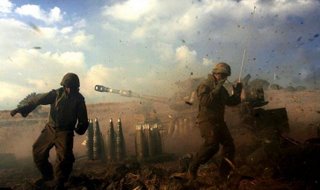
How quickly things change. It was only a year ago that Ariel Sharon was making a historic pullout from the Gaza Strip and it appeared to me that a future peace in the Israel-Palestine conflict was at least not an impossibility. Now, the Middle East is engaged in its worst crisis since the Israeli invasion of Lebanon a quarter-century ago. Just last month I was reading From Beirut to Jerusalem, a history of that conflict--now its deja vu on the front pages.

Surprisingly, many people are blaming Israel for this latest flareup, an accusation I believe is unfounded. I think the U.S. position that Israel has the right to stop terrorist attacks (while not using disproportionate force) is a correct one. The current situation is different from those in the past, when I would generally take a more moderate tone with regards to the players. This time the instigator of troubles is very clear--Iran is fully culpable for fomenting instability in the region. This comes after Israel has shown good faith with its unilateral withdrawal from Gaza. This comes after Syria ended a decades-long occupation of Lebanon, giving that country its first chance for democracy and freedom to succeed.

But those signs of progress were too much to stomach for Iran and Syria, of course. Hence their war by proxy against Israel through the extremist groups Hezbollah (in Lebanon) and Hamas (in Palestine). Hezbollah, operating as an autonomous entity in Lebanon, makes a mockery of the institution of self-government in that country, and its actions bring suffering upon the Lebanese people. Likewise with Hamas, who lets it militant wing run unchecked while it neglects the basic operations of running a government.

Robin Wright writes in today's Washington Post that, according to U.S. estimates, Hezbollah receives "$100 million annually from Iran in goods, cash, and arms, including an estimated 13,000 rockets and missiles." That malevolent sponsor also happens to be closing in on attaining a nuclear bomb. Faced with enemies with capabilities like that, I echo David Brooks' incredulity that people think Israel is "overreacting." Israel should sit still and do nothing all this while? Of course not. And let's not act like the U.S. can't pick a horse to back here. The Islamist groups and their state sponsors hate the West and are impediments to the spread of freedom and democracy. Israel's actions against its enemies are in line with U.S. interests.

Yet it is important to remember the many, many innocent Lebanese and Palestinian civilians who are victims of this war. What is sad is that they are paying the price for the terrorists that operate from their land. These terrorists know full well the consequences their actions will have on their innocent countrymen, but that doesn't matter to them--only jihad does. Their destructive behavior dooms the people on whose behalf they claim to be fighting.

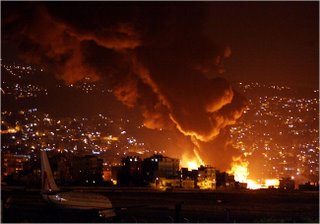
In this conflict, there is much suffering on both sides. When I see pictures of bombed out buildings and bridges in Beirut, I feel terrible, as I do when I see rockets landing in Haifa. That doesn't change the fact, however, that there is a clear right and wrong. Israel has the right and responsibility to protect its citizens by targeting its enemies. Those enemies aren't just Israel's enemies, they are the enemies of progress and a peaceful future in the Middle East, and everyone would be better off without them.

Is it possible that we can achieve that? Yes, but not with missiles and artillery shells. David Ignatius wrote in Friday's Post about the basic steps needed for a proper resolution to this mess. First of all, this conflict must not be the U.S. and Israel versus the Muslim world, because we are trying to bring the silent majority of moderate Muslims to confront the extremists in charge. The weak central governments that are being eclipsed by the non-state actors must be strengthened: a strong and responsive Palestinian Authority must exist so that it is not hostage to the Hamas militia, and an already pro-Western Lebanese government led by Fouad Siniora must be helped so that it can rein in Hezbollah.

The U.S. should provide assistance in this endeavor, because we--the U.S., Israel, and the Lebanese and Palestinian people--share a common enemy: the extremists. Once they are defeated, then we can look forward to a more hopeful future in the Middle East

Sunday, July 09, 2006

Review: The One Percent Doctrine

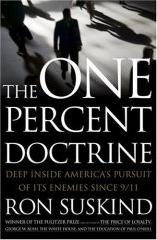
This past week I read Ron Suskind's best-selling new book The One Percent Doctrine: Deep Inside America's Pursuit of Its Enemies Since 9/11. Going in, I wasn't sure what to expect from the author of the first major book criticizing President Bush (2002's The Price of Loyalty, about then-Treasury secretary Paul O'Neill, which I have not read). Yet the subject matter was compelling enough for me to pick up the book. Now that I have finished reading it, I can say that this book is important enough to be required reading for all Americans who want to understand the nature of the post-9/11 threat this country faces and how we are responding.

The titular "one percent doctrine" is a reference to a quote by Vice President Cheney, in which he opines that catastrophic threats to the U.S. pose such a great danger that our country's response must be to react those threats with a 1% chance of occuring as being a certainty. Hence, it follows, preemption, unilateralism, renditions, etc.

Probably the first question many people have regarding this book: is it a partisan hatchet-job? The answer is no, and I admit being a little surprised myself here. Suskind's reporting of America's struggle to combat al-Qaeda in the pre-Iraq War years should earn him a medal. He provides an unsurpassed amount of detail into all the successes and setbacks of various U.S. counterterrorism operations.

Some parts of the book seem like Hollywood thriller material. My favorite story involved a CIA operation targeting "al-Qaeda's banker", Pacha Wazir. Afer quietly arresting Wazir and his associates, the CIA sent a few of its specially trained agents of Pakistani descent for an amazing undercover mission. Passing themselves off as distant cousins of Wazir, and explaining the latter's absence due to a family illness, the undercover agents took over Wazir's bank and continued to receive customers. This fantastic operation resulted in the capture of dozens of key terrorists.

Yet tempering triumphs like those are maddening passages like the one detailing how the U.S. bungled the apprehension of the eventual architect of the British 7/7/05 bombings due to bureaucratic tanglings. Another troubling story concerns the capture of Abu Zubaydah, originally thought to be a major al-Qaeda leader and whose apprehension was hailed by President Bush. Problem was, Zubaydah was soon found to be just a menial agent, and worse, a certifiable schizophrenic. Suskind writes that despite this, "the United States would torture a mentally disurbed man and then leap, screaming, at every word he uttered." Zubaydah would conjure up several plot details about attacks on shopping malls, supermarkets, and banks, leading law enforcement to squander valuable resources. Even so, it must be pointed out that in what is perhaps a victory for advocates of "rough" treatment of detainees, Zubaydah finally told his interregators about Jose Padilla.

If there is any story arc to The One Percent Doctrine, it is that Suskind finds former CIA director George Tenet to be a tragic hero--he describes Tenet as being "the man most responsible, if anyone is, that America has not, again, been attacked" and laments how Tenet became the "fall guy" for the Bush administration over the lack of WMDs in Iraq. Suskind is a huge critic of the Iraq war, and toward the end of the book he takes leave of just-the-facts reporting to slam the White House (and then-National Security adviser Condi Rice especially) for the way they handled the runup to the war.

Considering that this book contains terrific reporting about so many things the American public doesn't know about the war on terrorism, I was a bit disappointed to see Suskind's personal viewpoint start to weigh heavier later in the book. Nonetheless, I stand by what I said before, that the book does not come across as overtly biased. There is definitely enough here for any open-minded reader to see both sides and come to their own conclusions.

My only other complaint about this book, one I made frequently though it is minor, is Suskind's penchant for "florid" writing. I think his terse and gripping account of terrorist plots or key Cabinet meetings would have been better off, from the reader's point of view, without being constantly interrupted by sentences like these "The connected planet creates all manner of loops, where knowledge spurs action, which is captured in image and word and then cycled back--the mythical perpetual motion machine comes to life."

Considering the insignificance of the criticisms I have mentioned, I would strongly recommend this book. Besides getting a front-row seat in the bleachers down at Gitmo Bay, I can't think of a way to feel more "in the know" about the war on terrorism than to read The One Percent Doctrine.


Thursday, July 06, 2006

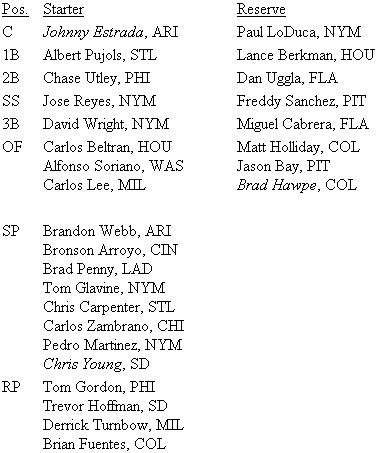
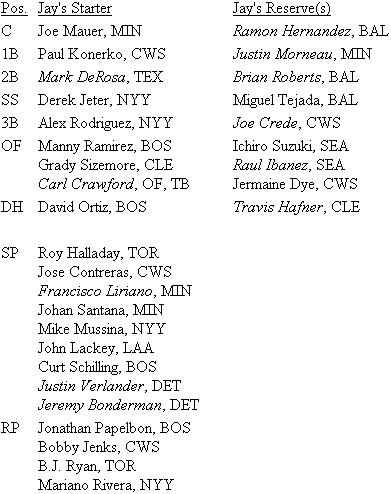
Jay's 2006 MLB All-Star Teams

It's official. The 2006 MLB All-Star Game rosters have been finalized in time for the Midsummer Classic on July 11 in Pittsburgh.

So let's get right down to the nitty gritty. I've long been critical of fan voting in these things because the same big-market stars get selected to the game every year, regardless of whether they deserve it or not. Of course, the argument here is that the All-Star game is for the fans, so they should get to pick who they see. Nonsense. It's not like the TV ratings for these games is all that high anyway, so I think fans should at least be given a reason to watch--to see the best players in the sport as determined by the players and the managers.

Anyway, this year I actually thought the selected teams were decent. There weren't too many eye-popping travesties to take note of, though the omission of the young Minnesota Twins phenom Francisco Liriano was one unfortunate example. Other than that, I think a true All-Star team should not have taken a catcher from the NL this year (none were particularly impressive), and I find it also unfortunate that there was no room for Travis Hafner on the AL team this year. I'd change that if I could.

Removing myself from the constraint of that rule that each team must have at least one player represented (sorry, Kansas City Royals!), I present below the real NL and AL all-star teams. Enjoy!

* * *
Jay's NATIONAL LEAGUE

Italicized names were not selected to the real MLB roster.


Honorable mentions: Nomar Garciaparra, 1B, LAD; Chris Capuano [July 9 replacement], SP, MIL; Aaron Harang, SP, CIN; Billy Wagner, RP, NYM; Ryan Howard, 1B, PHI

Jay's AMERICAN LEAGUE

Italicized names were not selected to the real MLB roster.


Honorable mentions: Jim Thome, DH, CWS; Nate Robertson, SP, DET; Joe Nathan, RP, MIN; Alex Rios, OF, TOR; Vernon Wells, OF, TOR

I'd be remiss to not mention that the AL outfielders' group is spectacular this year. Names I didn't mention that are certainly deserving include Vladimir Guerrero, LAA; Magglio Ordonez, DET [July 7 injury replacement]; and Gary Matthews Jr., TEX.

* * *

Have a grievance on behalf of any of your favorite players or fantasy studs? Think I should have put Tad Iguchi or Jose Lopez at second for the AL? Am I one Tiger starting pitcher short? Was I too hard to Cincinnati sluggers with less-than-stellar batting averages? Did I insult Vlad Guerrero and Johnny Damon by not even mentioning their names? Feel free to inform me of any mistakes you think I have made.

Tuesday, July 04, 2006

Siegel on The Future for Investors

I recently finished reading The Future for Investors (2005) by Dr. Jeremy Siegel, the well-known Wharton professor who authored the widely cited Stocks for the Long Run (1994). In his latest book, he outlines his methods for selecting winning stocks for the long-term in the context of current and future trends.

The major points of the book, as I saw it:

  • Beware the "growth trap"

    In a nutshell, this means avoiding overpriced companies and industries.

    According to Siegel, fixating on high-growth companies or pursuing technological innovation is a mistake. (The subtitle of the book, in fact, is "Why the Tried and the True Triumph over the Bold and the New.") Such stocks often have high price valuations that indicate substantial built-in investor expectations. Thus the difference between expected and actual earnings is less, producing lower returns.

    The same factor can apply to industries, where he says fast growth causes increased competition amongst companies and too-high investor expectations, both of which negatively impact returns. "The financial and technology sectors expanded greatly over the past years [since 1957]," he says, "yet gave mediocre to poor returns." The three best performing sectors, Siegel says, have been health care, consumer staples, and energy--the latter of which has experienced a "significant contraction in market share."

    Siegel extends the "growth trap" lesson even to the issue of emerging markets. He uses the example of comparing Brazil and China. From 1992-2003, Brazil's economy grew at only 1.8% a year, less than one-fifth of China's. China, Siegel points out, also had a stable currency, no inflation problems, and political stability; Brazil was the opposite. Yet investment returns in Brazil averaged 15% a year while in China returns average -10% a year. The reason: "low prices and high dividend yield."

  • Seek high dividend-yield stocks

    "From 1871 to 2003," Siegel writes, "97 percent of the total after-inflation accumulation from stocks comes from reinvesting dividends. Only 3 percent comes from capital gains." Dividends are the Holy Grail of Siegel's investing strategy. Companies that pay dividends regularly, he says, inspire shareholders' trust in management. More importantly, high dividend yields lead to higher returns, where re-invested dividends act as a cushion from a decline in price They also, due to the increased number of shares now owned by the investor, accelerate returns once a stock's price turns up.

    Siegel refers constantly to a list of the 20 top-performing survivor stocks of the original S&P 500. These companies, which beat the index over the past 47 years by between 2.8-8.9% a year, all paid dividends.

    One important point to consider here is the role of taxes, which Siegel glosses over. Of course, if you are investing in an IRA or other tax-sheltered account, this isn't a problem.

  • Foreign markets will play a vital role in the global economy

    The impending demographic crisis in the developed world, Siegel warns, will have consequences. With an aging population leading to more retirees (who are also living longer) supported by fewer workers, the assets of older people will decrease in value and force the retirement age upward.

    However, Siegel thinks the answer lies in what he calls the Global Solution--"aging populations in the richer countries...supported by the young workers in the developing world." He posits that the growth of emerging economies like China and India will allow young people in those countries to purchase the assets of older people in developed countries, allowing the latter to enjoy "an ever-lengthening retirement without any reduction in the standard of living."

    The emergence of China and India, along with other promising countries like Russia and Brazil, is not without precedent. Siegel points out that in terms of U.S. per capita income, Japan has gone from 20% to 96% in the past 40 years; Singapore from 14% to 58% in the same time. In the last 25 years, South Korea has gone from 17% to 50%. I found it interesting that he says China could achieve the same goal with a productivity growth rate half of what it has averaged over the last 25 years, meaning it's more than likely to happen.

Those were the topics in the book I found most interesting. Siegel also covers other investment strategies, which I am not advocating here, in less detail. The strength of his book, however, lies in its discussion of the aforementioned themes. If you already have some experience with the stock market, and are interested in a look at what lies ahead, I think you'll find it worth a read.