School without classes, homework, or grades. It's a common wistful refrain from students of all ages, from elementary school to college. The whole "getting an education" thing sure does get in the way of socializing and having a good time with friends. Nonetheless, virtually every student realizes the practical value of having a structured, formal education.
The Washington Post today reports on the minority that don't believe in such a regiment. The cover story "Learning on Their Own Terms" looks at the Fairhaven School, a private school that offers no courses, grades, set daily schedule, or official state accreditation, and which audaciously charges $6,680 a year for enrolled students. The idea behind the school is to remove the constraints of a traditional education and allow students to do whatever interests them--even if that means showing up to school at noon and spending the day playing video games and . Ultimately, the school relies only on the threat of boredom to spur its students to actually do anything.
Nonetheless, I understand why this might seem like a good idea to some. As a lifelong participant in the public education system, I can attest to its many flaws. A lot of what I did in school was unproductive, uninteresting, or meaningless. Yet I always realized that my education was a practical requirement for a future career.
The kids at Fairhaven do not come out of their school equipped with the skills necessary to be an engineer, doctor, or investment banker. Fine, not everyone wants to be one of those, and there many career paths from which a traditional education is not a necessity. The article states that alumni include "a professional skateboarder, a waiter and a librarian". It just seems to me that schools like Fairhaven and others in the "school without walls" genre are doing a disservice to their students by narrowing their potential career choices from such an early age. Fairhaven's youngest students are 5 years old, far too young to have their life options so limited.
If anyone has any dissenting opinions or can explain the practical benefits of such a non-traditional education (keep in mind that even home-schooled kids follow a set curriculum), I would love to hear from you.
Monday, April 24, 2006
School without Schooling


Monday, April 17, 2006
Permanent Records
From "Permanent Records":
Some time in or around the year 2030, I am sure I will be awakened one morning by the ringing of the hologram phone. The president — whether it will be Jenna Bush or Chelsea Clinton, I don’t know — will say to me: “Jay, I have bad news. You can’t be Fed Chairman/Secretary of War/Supreme Overlord after all. The opposition party’s got some dirt on you, and you’ll never make it through the confirmation hearing.”Click here to read the column.
As I sit there, dealing with my crushing rejection, I’d wonder what did me in. Was it the away message back in 2014 that said: “Skipping work today. At the baseball game”? Did my uncle violate U.N. sanctions by selling pop tarts to the Libyans — and then brag about it on his MySpace? Or did Sen. Chuck Norris threaten a filibuster over my membership in a Facebook group that claimed he is Jack Bauer’s girlie little sister?
Friday, April 14, 2006
South Park vs. Cowardly Central
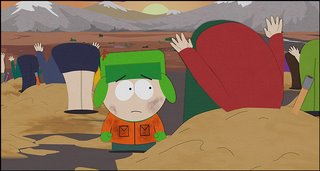 Having been laid out sick in bed for most of the past week, I finally got around to watching the recent, much talked-about South Park take on the Mohammed cartoons. And I have to say that the two-part "Cartoon Wars" episode was undoubtedly the smartest, most biting take on the controversy I have seen--better than any blog, op-ed column, etc. I'd also like to observe that just a few weeks after being ridiculed for pulling a South Park episode that poked fun at Scientology, Comedy Central has again stuck its head in the sand.
In the South Park spoof, America is gripped in fear when Family Guy (the stand-in show for South Park within the episode) decides to broadcast a cartoon of Muhammad. A terrified American public tries to avoid responsibility by burying their heads in the sand--quite literally. The few voices of reason who argue in favor of free speech are ignored. And the airing of the Muhammad cartoon in the U.S. is met by reprisal from Ayman al-Zawahiri and Osama bin Laden--who decide to produce their own offensive cartoon.
(On an unrelated note, the fact that Parker & Stone made a brilliant, funny satire while relentlessly lampooning Family Guy, a show I have soured on for the exact reasons South Park cites, made it twice as sweet.)
Of course, by now everyone has heard that Comedy Central censored the episode, removing South Park's innocuous depiction of the prophet Muhammad, a move anticipated by show creators Trey Parker and Matt Stone. While the frame with Muhammad was cut out, mirroring in fact the plot of the actual episode, Comedy Central had no problems running a purposely gratuitous scene involving President Bush and Jesus defecating on one another. How's that for a demonstration of the difference in tolerance?
Find a neighbor who Tivo'd it, and watch this episode!
Monday, April 03, 2006
Middle of the Road
My conservative friends consider me a liberal. My liberal friends call me a conservative. I think I like it that way. Am I a “moderate”? I suppose so, but I’m not sure I like that term. It implies one can’t have strong opinions or one must take practical stands instead of principled stands. Obviously, that shouldn’t be the case. People should be free to take firm stances on issues important to them. I just ask that you consider the legitimate arguments the opposite side makes. On every contentious issue, practice arguing from both sides so you can get an understanding of where the other guy is coming from.Click here to read the rest.