This week's BusinessWeek report that Facebook, the online networking site, could fetch up to $2 billion in a sale doesn't seem to have raised enough eyebrows--and that has me worried. The proposed sale to a media giant like Viacom seems to me to be yet another example of "Old Economy" types paying outrageous sums for "New Economy" technology and companies they don't really understand.
Yes, Facebook is enormously popular. In little over two years, www.facebook.com has become the 7th most visited site on the Internet. For those not in the know, Facebook is an online directory and networking site for college students (the site also recently expanded to high schools). There isn't a college student in America who hasn't heard of Facebook, and virtually all off them are users of the site. Facebook has transcended noun status to become a verb as well. On campuses, to "Facebook" someone is easily as common as the verb "Google" is in popular culture.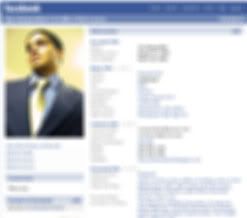 But for those of you above the age of 30 and not in the know, Facebook allows users at each school to post profiles and link to friends, classmates, and people with shared interests. My profile, for example (see right), has a picture of me along with details like my major (finance), contact info, clubs and jobs, and favorite music ("hip hop, classic rock"), books, movies, etc.
All this makes the company sound like a worthwhile investment. Rupert Murdoch certainly thought so. Last year, his News Corp. paid $580 million for MySpace, an online journal site which has been in the news lately because some people on the Internet--gasp!--publish lewd content or misrepresent themselves or prey on underage children. None of this has hurt MySpace, and Murdoch has been lauded for his forward-thinking. (Reuters CEO Tom Gloceg called the acquisition a "turning point", adding "Sites like MySpace are rebuilding our world.")
Yet I've heard no one propose any avenues for Facebook's continued growth over the years. Right now, its revenue comes from the advertisements on the site. I think, however, that advertisers will find that most high schoolers (and middle- and elementary- schoolers if Facebook goes down that route of Kids Without Credit Cards) aren't exactly the type to buy products online. Currently the site gets a lot of page views from its college students, but now that its presence is established, growth will level off.
All things considered, I just don't like the idea of a company which makes its money exclusively through advertisements. Google may seem to defy this notion, but at least that company has tremendous room for expansion. Even then, I thought Google CFO George Reyes delivered a long overdue announcement last month when he announced "Our growth rates are slowing... We are going to have to find new ways to monetize the business." Shareholders didn't like to hear that news, but I'm glad management is confronting a future challenge.
I've told college friends in the past that Facebook, were the company to ever go public, would be the perfect IPO to get in on and ride for the short term. When even people like David Brooks give inches in their newspaper column trying to understand this online fad (he declared Facebook "rollicking but respectable"), you know the company has drawn a lot of attention. But "fad" is a good keyword here. I can't identify a sound fundamental reason why it'd be a good idea to pay an outrageous sum of money to own this company. Facebook, for its command of the young demographic alone, is worth something, but my figure would be a fraction of that $2 billion. Sumner Redstone, consider this your warning!
Wednesday, March 29, 2006
$2 Billion for Facebook?


Tuesday, March 28, 2006
The Ink & Dead Tree Business
The recent sale and impending dismantling of the Knight-Ridder publishing empire seemed to be yet another sign of the unhealthy state of the newspaper industry. Yet in Monday's Washington Post, Robert Kaiser argues against that prevailing wisdom, saying "Newspapers have become some of the most profitable businesses in modern America."
While Kaiser argues, justifiably, that he prefers a newspaper to be privately held so as to be shielded from "Wall Street pressures", he says that most newspapers are nonetheless beating the 5-10% profit margin that traditional manufacturing industries like.
Is he right? I decided to look up how some leading newspaper publishers did in 2005, and for fun, compare that to the performance of some top companies in other industries. Check it out:
(Profit margin = net income / revenue)
All data via 2005 income statements from Yahoo! Finance.
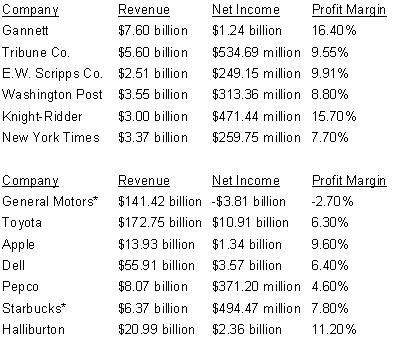
* - General Motors has not released fourth quarter results from 2005, so data is through three quarters. Starbucks fiscal year is Oct. '04 - Sept. '05.
So while Kaiser was exaggerating a bit, it does appear that newspapers are holding their own. The six publishers above are, in order, the largest newspaper publishers by market cap, and each of them are turning decent profit margins. (Though Knight-Ridder was just bought by McClatchy, who intends to sell a number of the KR papers.) Tribune stacks up favorably against Dell, a company with revenues in the same ballpark. Gannett can arguably be compared to Apple.
In this light, reports of the demise of the "ink and dead tree" business appear to be unfounded. What remains to be seen is how newspapers adapt to deal with competition from other mediums that are stealing advertising and providing alternative content.
While Kaiser argues, justifiably, that he prefers a newspaper to be privately held so as to be shielded from "Wall Street pressures", he says that most newspapers are nonetheless beating the 5-10% profit margin that traditional manufacturing industries like.
Is he right? I decided to look up how some leading newspaper publishers did in 2005, and for fun, compare that to the performance of some top companies in other industries. Check it out:
(Profit margin = net income / revenue)
All data via 2005 income statements from Yahoo! Finance.
* - General Motors has not released fourth quarter results from 2005, so data is through three quarters. Starbucks fiscal year is Oct. '04 - Sept. '05.
So while Kaiser was exaggerating a bit, it does appear that newspapers are holding their own. The six publishers above are, in order, the largest newspaper publishers by market cap, and each of them are turning decent profit margins. (Though Knight-Ridder was just bought by McClatchy, who intends to sell a number of the KR papers.) Tribune stacks up favorably against Dell, a company with revenues in the same ballpark. Gannett can arguably be compared to Apple.
In this light, reports of the demise of the "ink and dead tree" business appear to be unfounded. What remains to be seen is how newspapers adapt to deal with competition from other mediums that are stealing advertising and providing alternative content.
Monday, March 27, 2006
The Bright Side of American Business
Last week, I talked about foreign competition to U.S. business, citing reasons why countries like China and India are succeeding in the New Economy. But in closing, I also provided reasoning for why the U.S.'s strengths will allow it to maintain its superiority. For example, I offered that our "service-oriented economy" was equipped for the globalization era and pointed out that "our country is second to none at fostering an innovative and entrepreneurial environment."
In today's Washington Post, Sebastian Mallaby picks up where I left off to argue that "the heyday of American business may actually be now." Among the factors he lists are worker productivity, companies' return on equity, American management techniques, and better business practices. The "X factor", he says, is that we can meet contemporary challenges.
Read the whole article; it's an interesting counter to the popular notion that America's competitive edge is in decline. And, if you're discouraged by news stories about companies like Enron and GM, check out the newly released BusinessWeek 50. Apple, Halliburton, Amgen, Goldman Sachs, Starbucks, and a plethora of energy companies, among others, highlight the best that American business has to offer today. For now, it appears Uncle Sam is doing A-OK.
In today's Washington Post, Sebastian Mallaby picks up where I left off to argue that "the heyday of American business may actually be now." Among the factors he lists are worker productivity, companies' return on equity, American management techniques, and better business practices. The "X factor", he says, is that we can meet contemporary challenges.
American business excels at managing service workers and knowledge workers: at equipping these people with technology, empowering them with the right level of independence and paying for performance. So the era of decentralized "network" businesses is the American era.Moreover, America's business culture is perfectly matched to globalization. American executive suites and MBA courses are full of talented immigrants, so American managers think nothing of working in multicultural firms. The immigrants have links to their home countries, so Americans have an advantage in establishing global supply chains. The elites of Asia and Latin America compete to attend U.S. universities; when they return to their countries, they are keener to join the local operation of a U.S. company than of a German or Japanese one.
So the shift from manufacturing to services; the gallop of globalization; and the rise of information technology that flattens corporate hierarchies: All these forces come together to create an American moment.
Read the whole article; it's an interesting counter to the popular notion that America's competitive edge is in decline. And, if you're discouraged by news stories about companies like Enron and GM, check out the newly released BusinessWeek 50. Apple, Halliburton, Amgen, Goldman Sachs, Starbucks, and a plethora of energy companies, among others, highlight the best that American business has to offer today. For now, it appears Uncle Sam is doing A-OK.
Friday, March 24, 2006
The Evening News...Brought to You by Pepsi
Today, Matt Drudge links to recent commentary by legendary news anchor Walter Cronkite on the state of nightly newscasts today.
 Which really is a shame, considering that TV has the power to get the news across better than either of the aforementioned. I wonder why the evening news programs don't consider getting a corporate sponsor. Edward Murrow's See it Now program, portrayed in Good Night, and Good Luck, was sponsored by Alcoa. Today, as long as the corporate sponsor agreed to have no say in the content of the telecast, I think it would work. Take a cue from sports half-time shows and call it "ABC World News Tonight by IBM", have the logo featured on the set, and run one of their commercials mid-way thru the program.
Since it's primarily only old(er) people who watch the news anyway, maybe a company like Proctor&Gamble or Pfizer would see it in their interest to sponsor a show aimed at their target demographic? And with a guaranteed sponsor, the newscasts wouldn't have to stack their shows with "health and backyard" stories in order to attract an audience. I don't know if the economics of this idea make sense to a sponsor company or the networks, but it seems worth considering.
Unless things get of hand...
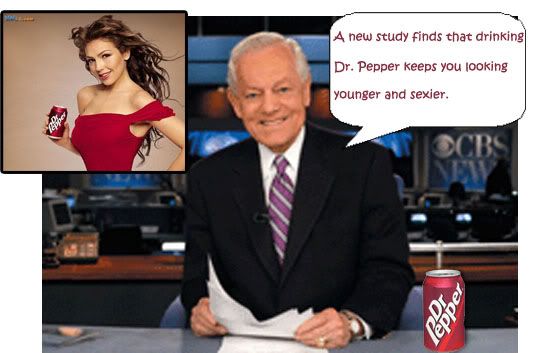
(Click to enlarge.)
Walter Cronkite has castigated producers of the network nightly newscasts for including stories about "your health and mine and your backyard and mine and all that kind of thing" at the expense of more substantive reports. "It doesn't belong in the evening news," Cronkite said during an interview...Cronkite, who knows a thing or two about real news coverage, is spot-on in identifying the problem with today's evening news. The networks, seeing a shrinking and again audience, run a news program with only 3 or 4 stories a night, interspersed between two long commercial breaks and a couple of "fluff" pieces. Despite the power of the medium, there's no doubt that people are better served by the more in-depth coverage of newspapers and the Internet.
"We're the most important nation in the world ... and there are these other very important stories in a very complicated world that we need to cover. We can't do that in 15 or 16 minutes." Apparently suggesting that the television networks ought to dispense with commercials during their nightly newscasts, Cronkite remarked, "The networks should be giving us the full half hour... It's ridiculous to have as little time as we have."
Which really is a shame, considering that TV has the power to get the news across better than either of the aforementioned. I wonder why the evening news programs don't consider getting a corporate sponsor. Edward Murrow's See it Now program, portrayed in Good Night, and Good Luck, was sponsored by Alcoa. Today, as long as the corporate sponsor agreed to have no say in the content of the telecast, I think it would work. Take a cue from sports half-time shows and call it "ABC World News Tonight by IBM", have the logo featured on the set, and run one of their commercials mid-way thru the program.Since it's primarily only old(er) people who watch the news anyway, maybe a company like Proctor&Gamble or Pfizer would see it in their interest to sponsor a show aimed at their target demographic? And with a guaranteed sponsor, the newscasts wouldn't have to stack their shows with "health and backyard" stories in order to attract an audience. I don't know if the economics of this idea make sense to a sponsor company or the networks, but it seems worth considering.
Unless things get of hand...
(Click to enlarge.)
Monday, March 20, 2006
Tags Calls it Quits
The announcement today that NFL commissioner Paul Tagliabue will retire this summer after serving for the past 16 years was a bit of surprise to most. "Tags", who succeeded the legendary Pete Rozelle, has been at the helm of the NFL for almost my entire life. And what a terrific job he did!
Football today is the indisputable favorite sport in America today, and none of the three other professional leagues comes close. Baseball may be the "national pastime", but casual baseball fans started deserting that sport a decade ago, and even serious fans today see a sport diluted by scandal and lack of excitement. Basketball's popularity peaked in the mid-90s, but following the retirement of the superstars of the Michael Jordan generation, went into a malaise that it is only now slowly coming out of. And hockey...haha, well that never had a chance.
I read with appreciation Dan Wetzel's remembrance of Tagliabue's contribution to the game. As we wait for the announcement of his successor, I have only one thought--sorry Condi ($), you're "under contract" till '08!
Football today is the indisputable favorite sport in America today, and none of the three other professional leagues comes close. Baseball may be the "national pastime", but casual baseball fans started deserting that sport a decade ago, and even serious fans today see a sport diluted by scandal and lack of excitement. Basketball's popularity peaked in the mid-90s, but following the retirement of the superstars of the Michael Jordan generation, went into a malaise that it is only now slowly coming out of. And hockey...haha, well that never had a chance.
I read with appreciation Dan Wetzel's remembrance of Tagliabue's contribution to the game. As we wait for the announcement of his successor, I have only one thought--sorry Condi ($), you're "under contract" till '08!
Finish Your Homework!
The popularity of the "flat world" idea and the notion that China and India will be eating our lunches in the not-too-distant future rank among the reigning themes discussed over the past few years. During this time, Thomas Friedman's book, Bill Gates' analysis of the American brain drain, and worries about outsourcing have permeated the popular consciousness. On the flip-side, counter-arguments have emerged in recent months which claim that America's preeminent status is not in jeopardy. See, for example, David Brooks ["The Nation of the Future" ($), 2/2/06] and Robert Samuelson ["A Phony Science Gap?", 2/22/06].
While I'm not one to turn alarmist from a few anecdotes about Beijing or Bangalore entrepreneurs, I do think that there is something to be concerned about here. The most important lesson on this subject that I have taken away comes from a story that Friedman relates:
Innumerable factors currently stand in the way of either China or India outstripping us, but one thing is clear: there are a lot of people in both of those countries that are out-hustling us Americans. While for now they may only represent a minority of their population, more of them are springing up daily to take advantage of increased opportunities.
For a taste of the radically different work culture in those countries, check out this recent Fortune article on Infosys, the Indian software services company. The talent pool is staggering--1.3 million applicants for full-time positions last year, and only 1% of those were hired. The new hires receive rigorous training in state-of-the-art educational centers which house rooms like the "Gordon Moore Room" or "Jeff Bezos Room". Captains of industry, it appears, are to the outsourcing industry what Kelly Clarkson is to the American public--the real Idols.
For now, the lure of higher salaries and brand-name jobs in the U.S. may draw a lot of the immigrant talent pool, as it did with my parents 25 years ago. But with increased prosperity and the prospects of "boundless growth" back in their native countries, how much longer will those smart foreigners keep coming here?
I'm willing to believe that the American optimists are correct when they assure us that we still do produce enough engineers and scientists, that because our country is second to none at fostering an innovative and entrepreneurial environment, and because we are a service-oriented economy anyway, that we can remain successful in the New Economy. But does that mean we should nevertheless continue with business as usual, not worrying about the fact that the rest of the world is working night and day to whittle away at our lead? I don't think so.
Better finish that homework.
While I'm not one to turn alarmist from a few anecdotes about Beijing or Bangalore entrepreneurs, I do think that there is something to be concerned about here. The most important lesson on this subject that I have taken away comes from a story that Friedman relates:
"When I was growing up, my parents would tell me 'Finish your food, people in China and India are starving.'
I tell my kids 'Finish your homework, people in China and India are starving for your job.'"
Innumerable factors currently stand in the way of either China or India outstripping us, but one thing is clear: there are a lot of people in both of those countries that are out-hustling us Americans. While for now they may only represent a minority of their population, more of them are springing up daily to take advantage of increased opportunities.
For a taste of the radically different work culture in those countries, check out this recent Fortune article on Infosys, the Indian software services company. The talent pool is staggering--1.3 million applicants for full-time positions last year, and only 1% of those were hired. The new hires receive rigorous training in state-of-the-art educational centers which house rooms like the "Gordon Moore Room" or "Jeff Bezos Room". Captains of industry, it appears, are to the outsourcing industry what Kelly Clarkson is to the American public--the real Idols.
For now, the lure of higher salaries and brand-name jobs in the U.S. may draw a lot of the immigrant talent pool, as it did with my parents 25 years ago. But with increased prosperity and the prospects of "boundless growth" back in their native countries, how much longer will those smart foreigners keep coming here?
I'm willing to believe that the American optimists are correct when they assure us that we still do produce enough engineers and scientists, that because our country is second to none at fostering an innovative and entrepreneurial environment, and because we are a service-oriented economy anyway, that we can remain successful in the New Economy. But does that mean we should nevertheless continue with business as usual, not worrying about the fact that the rest of the world is working night and day to whittle away at our lead? I don't think so.
Better finish that homework.
Friday, March 17, 2006
Gatorade: "Winning Formula"
What if Michael Jordan had missed "The Shot" against the Cavaliers in 1989? Or if Derek Jeter's flip to Jorge Posada in the 2001 MLB playoffs didn't get Jeremy Giambi at the plate? Or if Dwight Clark dropped "The Catch"?
Gatorade's new "Winning Formula" commercial is one of the most clever ads I have seen in a long time. In a similar vein to Burger King's amusing series of commercials featuring "the King" edited into football highlight reel plays, Gatorade has edited some of the most memorable moments in sports to show you what they would have looked like had they gone wrong. The computerized manipulation is flawless--if you've never seen the original plays, you wouldn't know the difference!
I hit rewind on my Tivo twice to watch this commercial again--it's that good. Click on the play button below to view:
I hope they turn this into a series of commercials featuring even more altered sports moments. Very cool!
Gatorade's new "Winning Formula" commercial is one of the most clever ads I have seen in a long time. In a similar vein to Burger King's amusing series of commercials featuring "the King" edited into football highlight reel plays, Gatorade has edited some of the most memorable moments in sports to show you what they would have looked like had they gone wrong. The computerized manipulation is flawless--if you've never seen the original plays, you wouldn't know the difference!
I hit rewind on my Tivo twice to watch this commercial again--it's that good. Click on the play button below to view:
I hope they turn this into a series of commercials featuring even more altered sports moments. Very cool!
Wednesday, March 08, 2006
Rooting Against Barry
It should have been Griffey, if anyone. That's what I've been saying to myself in recent weeks as the 2006 baseball season draws nearer. The biggest storyline going in, of course, is Barry Bonds' pursuit of the all-time home run record. It's a given that Barry, with 708 career HRs, will surpass #2 Babe Ruth (714), but true baseball fans also appear resigned to seeing Barry displace Hank Aaron (755). You'll forgive me for rooting against Barry I hope, regardless of how futile my efforts may be.
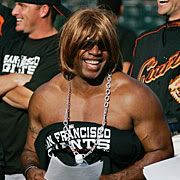 Barry Bonds is just not the guy I want to see holding what is perhaps the greatest individual accomplishment in American sports. He's a royal jerk. He admitted to a grand jury in 2003 that he took the steroids "cream" and "clear", though he says he did so "unknowingly". OK, fine, I've agreed with giving him the benefit of the doubt and calling him one of the greatest players of all time. But let's face the facts. In the first half of his career, as a home-run hitting speedster, Barry was a great player. But he became legendary through his power resurgence of the past six years, which began as he was a ripe old 35!
What's the explanation for the dominance of this second Barry? The answer might come from the upcoming book Game of Shadows by the reporters who broke the BALCO steroids scandal. The book alleges frequent, systematic use of steroids by Bonds since 1998. Read the length excerpt in Sports Illustrated here, or get the lowlights here. It's grotesque, fascinating reading, and it's virtually assured now that the primary topic of baseball conversation isn't going to be the Nats' new stadium or the exciting games being played in the World Baseball Classic.
Six or seven years ago, I anticipated seeing the home run record being broken by a star outfielder of the time. That player was Ken Griffey Jr., the greatest baseball player of the '90s. For the record, I calculated the HR totals of Griffey and Bonds at the end of the 2000 season. Bonds had 445 HRs, Griffey 438--with the former being 5 years older and having played 3 more seasons. Of course, since then injuries have derailed every one of Griffey's seasons, while Barry Bonds has (most likely) been injecting, swallowing, and rubbing. (Or, as Kornheiser puts it, "Bonds was taking all of Aisle 7 in the Rite-Aid!")
Good for Barry Bonds if he gets the record. I'll be watching, but I won't be cheering.
CB Archive:
Barry Bonds is just not the guy I want to see holding what is perhaps the greatest individual accomplishment in American sports. He's a royal jerk. He admitted to a grand jury in 2003 that he took the steroids "cream" and "clear", though he says he did so "unknowingly". OK, fine, I've agreed with giving him the benefit of the doubt and calling him one of the greatest players of all time. But let's face the facts. In the first half of his career, as a home-run hitting speedster, Barry was a great player. But he became legendary through his power resurgence of the past six years, which began as he was a ripe old 35!What's the explanation for the dominance of this second Barry? The answer might come from the upcoming book Game of Shadows by the reporters who broke the BALCO steroids scandal. The book alleges frequent, systematic use of steroids by Bonds since 1998. Read the length excerpt in Sports Illustrated here, or get the lowlights here. It's grotesque, fascinating reading, and it's virtually assured now that the primary topic of baseball conversation isn't going to be the Nats' new stadium or the exciting games being played in the World Baseball Classic.
Six or seven years ago, I anticipated seeing the home run record being broken by a star outfielder of the time. That player was Ken Griffey Jr., the greatest baseball player of the '90s. For the record, I calculated the HR totals of Griffey and Bonds at the end of the 2000 season. Bonds had 445 HRs, Griffey 438--with the former being 5 years older and having played 3 more seasons. Of course, since then injuries have derailed every one of Griffey's seasons, while Barry Bonds has (most likely) been injecting, swallowing, and rubbing. (Or, as Kornheiser puts it, "Bonds was taking all of Aisle 7 in the Rite-Aid!")
Good for Barry Bonds if he gets the record. I'll be watching, but I won't be cheering.
CB Archive:
- "Too Late to Say It Ain't So, Raffy" (August 3, 2005)
- "'Roid Rage" (February 14, 2005)
Wednesday, March 01, 2006
Defending Bush on the Ports Deal
Richard Cohen emerges as another unlikely Bush defender over the UAE ports deal. (His Post colleague David Ignatius and the New York Times' Nick Kristof have also written columns this week taking a similar stance.) I cut out the article and highlighted the following few paragraphs to show to Muslim friends:
The politic thing for a president with a dismal approval rating (about 40 percent) would have been to join with the critics, get ahead of the anti-Arab wave and announce that he, too, was concerned about the deal, which was the fault, now that he thought about it, of pointy-headed bureaucrats, Democrats and the occasional atheist. Instead, the White House stuck to its guns, ordering a symbolic retreat -- more study -- but continuing to back the deal.
That Bush has done this should come as no surprise. As a bigot he leaves a lot to be desired. He has refused to pander to anti-immigration forces, and shortly after Sept. 11, if you will remember, he visited Washington's Islamic Center. He reassured American Muslims and the worldwide Islamic community that neither America nor its government were waging war on an entire people.
"The face of terror is not the true faith of Islam," Bush said back then -- and he has since repeated this message over and over again. That very year -- in November 2001 -- Bush invited 52 Muslim diplomats to a traditional Iftar dinner, breaking the daily Ramadan fast, and he has occasionally cited purported racism as the reason some people doubt the Muslim world will, as Bush so fervently wishes, make progress toward democracy. They think people whose skin is "a different color than white" are incapable of self-government, he has said.
Subscribe to:
Posts (Atom)