Monday, January 30, 2006

The Speech Bush Should Give

My first column as an op-ed writer for the University of Maryland's Diamondback runs today, addressing tomorrow's State of the Union.
On Tuesday President Bush will, for the sixth time, deliver the State of the Union address. News reports state he is still working on his big speech. Luckily for him, I’ve taken the liberty of preparing the remarks he should deliver tomorrow night:

Good evening and thank you all for being here. Originally, I planned to come out and talk about the “war on terror” in a superficial manner, sprinkled with a liberal dose of tough rhetoric. Then, to further pander to the FOX News crowd, I was going to talk about tax cuts. Luckily for the rest of you, my good friend Jay intervened. He suggested that what the majority of American people are looking for is for me to be open and straightforward with them. Tonight, I promise I will not “spin,” I will not smirk and I will not mispronounce the n-word. “Newkillyear” … “nyookiller” … well, nevermind.

[Click to read the rest of "The Real State of the Union"]

In accordance with the Diamondback's rules on professionalism, I ask that family members and non-UM friends post any comments on this blog page rather than on the school paper's site.

Additionally, some of you may notice a similarity between Friday's Thomas Friedman column and my own. Rest assured, I am not the next Jayson Blair (who, incidentally, was a Maryland alum and former Diamondback editor). The Diamondback's publication schedule is such that I initially submitted my column last Monday, a full week ago, and four days before I saw Friedman's piece. Great minds think alike?

Writing for a student newspaper is different from blogging; anyone have ideas?

Tuesday, January 24, 2006

Google, China, and "Do No Evil"

Disappointing news from Mountain View, CA today, as Google announces that the Chinese version of its search engine (debuting Wednesday) will adhere free speech restrictions at the request of China's communist government. The AP reports:
Google agreed to omit Web content that the country's government finds objectionable. Google will base its censorship decisons on guidance provided by Chinese government officials.

Examples of objectionable content could include information about the Tiananmen Square massacre, Taiwan, Falun Gong, and the Dalai Lama.

In Google's defense, a company executive replied:
“While removing search results is inconsistent with Google’s mission, providing no information (or a heavily degraded user experience that amounts to no information) is more inconsistent with our mission.”

Necessary evil? It's debatable. I've blogged about this topic before in connection with Yahoo! and Shi Tao, and realize there are no easy answers. But what makes this news all the more disheartening is that it flies contrary to the company's famous and long-standing philosophy of "Do No Evil." One of the chief aspect's of Google was its reputation as a white knight of industry that led by example. On Google's homepage, you can look up their corporate philosophy, which they sum up in a list of "Ten things". The list, by the way, includes the following:
4. Democracy on the web works.

6. You can make money without doing evil.

And my favorite:
8. The need for information crosses all borders.

CB Archive:
"In China, 'Business as Usual' is Bad" (Sep. 19, 2005)

Saturday, January 21, 2006

Sensible Proposals from a Democrat

Rep. Harold Ford Jr. (D-TN) has a good piece in today's Washington Post entitled "Keeping the Progress Going". While he doesn't have anything particularly groundbreaking to say, I was impressed with the moderate, constructive position he stakes out on a number of issues. Considering he lost out to Nancy Pelosi for the Democrats' House leadership position, I can only imagine the different position the part would be in had his agenda been in place. After all, on one hand you have the Bush administration, detached from some of the harsh realities of war and diplomacy as well as the need to respect constitutional authority at home. On the other hand, you have the Democratic party leadership of Reid and Pelosi who operate reflexively against Bush and the Republicans without offering any constructive solutions of their own.

Ford is a realist. He acknowledges progress in Afghanistan and Iraq and rejects the idea of some of his Democratic colleagues that American troops should return home immediately. Says Ford, "I want the troops home as much as anyone, but having to send another generation to that region to fight 10 or more years from now because we left too early would be a worse outcome than the situation we now face. We need to do this right the first time." Amen, brother.

His platform includes a call for Bush to end his controversial domestic spying program ("We are a nation of laws. We cannot be in the business of exporting democracy and liberty if we cannot protect it at home.") Yet Ford does not deny the president the authority needed to protect national security; he just suggests that legislation in Congress create the necessary adjustments to the current system.

Ford's also puts in a call for an increased commitment to improved foreign relations. That in itself is a generic sentiment, but I was pleasantly surprised that his affirmation of the U.N. contained a push for reform of that organization--an idea that is a staple of the right-wing.

Why aren't more Democrats putting forth definitive positions and constructive ideas instead of engaging in endless partisan sniping or self-aggrandization? Ford is running for the Senate in 2006; I hope he succeeds. The Democratic Party, if it wants the public to realize that it stands for something, should be promoting more intelligent voices like Harold Ford's. He shows us there is a viable middle ground between caving to the Bush administration and the hysteria of the extreme left-wing.

Thursday, January 19, 2006

Where's the Fan Accountability?

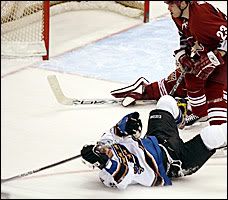
Alex Ovechkin's amazing goal against the Coyotes on January 16.  (Photo: AP)It's been a real busy week in the news, but as my last week of winterterm classes winds up, I haven't had much time to comment on a number of stories. Among the week's best: Nicholas Kristof on China or India? The Next Superpower, more NFL playoff action, the return of 24, the return of Osama, a showdown with Iran, Laura vs. Hillary, and phenom Alex Ovechkin's "best goal ever" (see video). An issue I do want to quickly address, however, stems from the 5-game suspension handed down to the Knicks' Antonio Davis for charging into the stands to defend his wife from a heckler last night.

Everyone has made the inevitable comparison to what happened in Detroit last year, when Ron Artest's response to fan behavior involved brawling in the bleachers. But while many have been quick to crucify Davis for acting irresponsibly--he did, and the penalty fits, but who wouldn't do the same in defense of his wife?--the disturbing trend of increased fan misbehavior goes largely unnoticed.

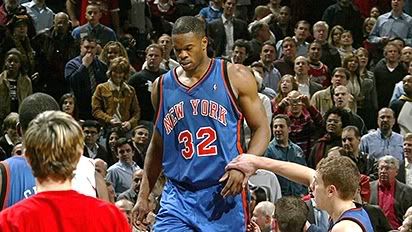
The Knicks' Antonio Davis.  Photo: ESPNI've been attending sporting events for over a decade now, and I may be naive in saying this, but I think sportsmanship has gone down a lot from what I remembered. Support of one's team is great, of course, but there are lines that shouldn't be crossed. Razzing a fellow wearing the wrong colors is one thing, verbally and even physically assaulting him is something entirely different, and neither infraction is defensible.

Every weekend it seems there's another story about unruly fans. That was certainly weighing on my mind when I was up in Philly a few weeks ago to cheer on the Redskins on the road. While I emerged unscathed, Clinton Portis' mom had to punch out a drunk heckler who poured beer on their group. Targeting family and friends of opposing players? No class.

Let's face the facts. If you are a fan cheering for the visiting team at a contest, you know you're in for a rough ride. These are no longer family-friendly events, if, as we're led to believe, they once were. Because it's clear that increased belligerence and unsportsmanlike behavior is not just tolerated, but perhaps even encouraged under the guise of "team loyalty", home teams need to a better job with providing more security.

Furthermore, let's see real punishments for serious offenders--starting with prosecution. People make a big fuss when they see their "spoiled, multi-millionaire athletes" rumbling in the stands. Those guys are held accountable. Fans should be accountable for their behavior, because it's not their birthright to go and act as obnoxious as they want. I want to go see a baseball/ football/ basketball/ hockey game, not a soccer riot.

Tuesday, January 10, 2006

The "Pay More, Get More" Army

Fred Kaplan has a very interesting article in today's Slate about the new relaxed standards for Army recruitment. Apparently, due to the Iraq war's strain on filling quota, the Army is filling its ranks with "Category IV" applicants, those who score near the bottom on the armed forces aptitude test. Historically there have been legally defined limits to the number of these Category IV personnel--a maximum of 2% in the '80s, upped to 4% last September. Even then, in 2004, at a time the Army was not faced with its current recruiting crisis, Kaplan says that only 0.6% of Army personnel were Category IV. However, in October 2005, 12% of new recruits were Category IV, and November likely saw at least that many if not more.

Now of course, these men and women have all the courage and training that you'd expect from any member of the armed forces. They can do their job capably and admirably. However, as Kaplan argues, the statistics show that smarter soldiers do make better soldiers. Kaplan cites studies done on soldiers' effectiveness at a wide range of tasks, from tank gunning to manning and repairing communications systems gear to firing Patriot missles. Overwhelmingly, the evidence is clear. "The higher the score on the aptitude test," he says, "the better the performance in the field. This is true for individual soldiers and for units."

None of this is meant as a slight to any armed forces personnel, who do a vital job and who do it well in defense of our country. In order to do the job properly in Iraq we need sufficient manpower on the ground. At a time when the pressure to deliver recruits is, the Army is doing all it can to get the job done, and the sacrifice of anyone who joins this cause is well appreciated.

That said, better soldiers make a better Army which does a better job. Wartime recruiting is much harder than peacetime recruiting. If the administration and the folks at the Department of Defense really care, how about offering better pay and benefits to attract better candidates rather than lowering your standards? Serving your country is an honorable calling, but for too many people who might otherwise be willing, it is not a viable one. Let's change that.

Sunday, January 08, 2006

Familiar Name in the Times

Ever since the New York Times published its bombshell story about the government's warrantless wiretapping of American citizens, backers of the Bush administration have been outraged at what they see is an illegal leak of sensitive information. The Times has categorized their sources as whistleblowers who, as author James Risen related on "Meet the Press" today, "believed that there was illegal activity" going on.

Meanwhile, many right-wingers have predictably tried to obscure debate over the real issue at hand by focusing on the leak rather than the possible abuse of executive power. PowerLine angrily declared "throw 'em in the slammer" when the Justice Department launched its investigation last week. Of course, the administration has known about the leak for a year now, and only just now launched its investigation. My dad raises this point in a Sunday letter to Byron Calame of the Times:
You missed a crucial point about the timing of the Justice Department's opening of "an investigation into the disclosure of classified information about the eavesdropping." If the Bush administration knew about this leak for a year, why didn't the president ask the Justice Department to probe the leak back then?

How is national security better served now by going into what a possible whistle-blower did a year ago? Hasn't the damage already been done? The investigation now reeks of political opportunism, as opposed to genuine national security concerns.

JACK NARGUNDKAR
Germantown, Md., Jan. 3, 2006

To me, looking into the identity of the government whistleblowers is trivial compared to a thorough investigation into the legality of the domestic surveillance program. Let's see some answers on that front.

CB Archive:
"Spying Storm Will Blow Over" (December 30, 2005)
"Spy Games" (December 21, 2005)

One Year of Citizens Band

Today marks the one-year anniversary of this blog. On January 8, 2005, I started Citizens Band with a vision that has changed somewhat since the site's inception. CB was initially intended to be a team blog but I quickly decided to keep this site a record of my own opinions. That's not all that has changed, however.

I think this blog has played an instrumental role in helping me become more aware of current events and has really made me develop my writing and argumentative skills. Whereas a year ago I relied mostly on summarizing articles in the news, increasingly I am able to offer more of my own original analyses, place stories in context, and make comparisons. I now consider myself much more politically savvy before, and I can attest that my exposure to different ideologies has changed or moderated my viewpoints on a number of issues.

I hope to do a lot more with this site in the year to come. In the past year, I posted infrequently, often taking weeks or even month long hiatuses. Hence the fact that this is, by my estimate, only the 80th post on this site. In the future I would like to keep this site updated on a daily basis, and utilize more photos, video, and audio to make posts more interesting. I've already started to move away from relying exclusively on long-winded essays (this post not the best example) and I want to add more links to interesting stories which I may only briefly comment on. My hope is that making this a more user-friendly site with more content and more interesting topics will attract a greater readership for this site, which still sees few eyeballs.

Anyway, it's been a great year and I've had a lot of fun with this site. Stay tuned for what's to come, I think it's going to be good!

Saturday, January 07, 2006

The Future of Newspapers

In today's Washington Post, Michael Kinsley has an entertaining analysis of what plagues the newspaper industry, which he says is a victim of inefficient production and distribution procedures and a product not tailored to customer's desires. I thought this description of a reader's interaction with a newspaper was particularly accurate:
The proud owner of up to four or five pounds of paper and ink begins searching for the parts he or she wants... [A]t last, there are two piles of paper: a short one of stuff to read, and a tall one of stuff to throw away. Unfortunately, many people are taking the logic of this process one step further. Instead of buying a paper in order to throw most of it away, they are not buying it in the first place.

One of the big reasons for the newspapers' decline is the convenience of the Internet; in order to compete, Kinsley says, "they will have to bring it to me in bed." In bringing up a list of advantages newspapers have, he cites the "brand name" authority that newspapers possess, though he wonders whether that still carries the same weight it once did.

What Kinsley only barely alludes to, however, is "content". What I think is the newspapers' greatest strength are the resources they possess to cover all manner of events, be they domestic or international. A lot of old suits might be worried about the Internet and bloggers, but a blogger primarily fills the role of an opinion columnist. No one popular blog site does much if any independent reporting, and certainly could never dream of having the scope of even a mid-size newspaper.

Newspapers will survive, but to thrive, they're going to have to change their business model. Kinsley has an intriguing solution. He points out that what customers pay for a newspaper doesn't come close to covering its production cost--it is only through the money reaped from advertising that the paper covers its costs and turns a profit. I find this somewhat analogous to movie theaters, which don't make much money off ticket sales--despite their exorbitant prices these days--but rather through the concession stands. (That explains the $5 Coke and $6 bucket of popcorn.)

So, Kinsley says, why not offers newspapers for free? If advertisers go along with this, agreeing to pay more in exchange for more eyeballs, everyone wins. I don't know how feasible this idea is, but it certainly seems worth investigating. If there's one thing everybody likes, it's free stuff. Were newspapers to be offered for free, I'm certain many more people would be interested in reading them without feeling like they were wasting money on an "unnecessary" expense.

It's not something that's never been done. Those of you living in the MD-DC-VA area may have seen copies of The Examiner, a free daily paper, lying around. Yet something like this will never catch on unless a heavyweight latches on--the "brand name" authority that Kinsley talks about. For now, papers like the New York Times and Wall Street Journal seem content to charge $1 a day (and the Sunday edition of the Times is a whopping $4), so for those of us looking to catch a break, it's just wishful thinking.

Thursday, January 05, 2006

Rose Bowl & the NFL Draft

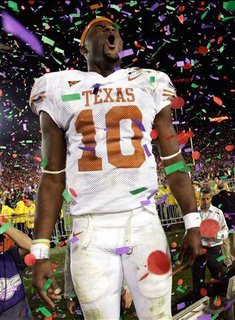
Vince Young.  Photo by Mike Blake/ReutersThere's little need in a blow-by-blow recap of last night's Rose Bowl, since pretty much everyone in the country watched it and commented it. Nonetheless, since it was a game for the history books, there are a few things worth talking about. With less than 7 minutes in the 4th quarter and a 12 point lead, the Trojans looked like their ridiculously long winning streak was going to stay intact (they hadn't lost, in fact, since squaring off against some guy named Odysseus). Then Vince happened.

Regardless of what Vince Young does for the rest of his life, his heroics in this game will be what defines him. What a magnificent individual performance--he simply willed his team to victory. He did it through the air and he did it on the ground, running for 200 tough yards against the SoCal defense, stiff arming guys, hurdling, diving, doing whatever it took. Two touchdowns in the final six minutes of the game. He simply was not going to let his team lose.

Meanwhile, the game was a letdown for Young's Heisman-winning opponents. Leinart in fact played a good game, especially in the second half, but I was disappointed with Bush. Although he had a decent game, he was overshadowed by his backup LenDale White's 3 TDs, and Bush certainly didn't make it 100% clear that he should be the #1 pick in the NFL draft, in my opinion. Hell, with less than 4 minutes in the game and USC needing to sustain a drive to hold on the win, Bush--the best player on his team--doesn't even touch the ball once? On a game-deciding 4th and 2, he's on the sidelines? Very disappointing. Bush is a terrific talent who had a great season, but he just didn't seem like a big-game player in the biggest game of his life.

So now that I've opened a can of worms, let's jump right into the NFL draft. The prevailing wisdom suggests that the Texans should take Bush #1. I don't know. The Texans desperately need a QB as well. David Carr, a former #1 himself, has had his career wrecked by starting out with the expansion Texans. He's done playing any meaningful football. Vince Young's outstanding performance, combined with his status as a Texas native, might convince Houston that he is just the facelift and fan favorite the franchise needs. Assuming Houston doesn't trade down, and they well might given their laundry list of needs, Young is the type of mobile quarterback they will need to avoid all the pressure he will be facing (and it will be a lot, no doubt). The Texans can get by with Domanick Davis, a capable running back, or draft a perfectly good one later in the draft--maybe even LenDale White.

Reggie BushI have nothing against Bush, who hails from my old hometown of San Diego and has a much better personality than Young, but I'm just not sure he's going to be the huge-impact player in the NFL that he's projected to be. NFL defenses are a lot faster and stronger than any Bush has run against, and with him being a speed runner as opposed to a power runner, that could cause problems. Splitting carries with White at USC, Bush hasn't really had to be a workhorse before, and his small size could also work against him. This is not to say, of course, that Bush won't be a success. He could in fact be a dazzling one, a player who runs like Tiki Barber has of late, but I think it's a risk and not in Houston's best interest. Especially considering that many very good running backs can be found later in the draft, as is evident by guys like Rudi Johnson, Stephen Davis, Ahman Green, and Terrell Davis.

And of course there's Matt Leinart, last year's golden boy who returned to school for another year and played very well. He's third in stature right now to Bush and Young, but I think of the three he's the least risky pick. A mature, confident pocket passer--this guy would be a great fit for many teams, and I think he will have a good pro career. He'll just wind up going after Bush and Young in the draft.

Bottom line: I'm trying to ignore the hype of Young's great game last night and keep in mind that Bush had a great season, but.... If I were the Texans and had decided to hold on to the #1, I'd be hoping that Young declares for the draft.