Saturday, May 27, 2006

On Elite Colleges and Success

In high school, I attended a prestigious magnet program where many of my fellow students were admitted to top-tier colleges like Stanford, MIT, and the Ivy League schools. On the other hand, I accepted a scholarship to my state school, the University of Maryland, where I just completed the second year of my undergraduate program. Although I am completely satisfied with my decision and I love being at UMD, I have often wondered what the impact on my life would be had I gone somewhere else.

I consider talent and hard work to be more important than any other factor as a determinant of success. Yet I can certainly see the advantages of going to a big brand-name school. Especially as a finance major I can see the benefits of having an established network, prestigious background, and a cohort of fellow successful students. That is why, I'll admit, I have long planned on getting an MBA from a Wharton or Harvard-level program.

It was interesting, then, to come across this article, which states that among "equally talented students who applied to the nation's most elite institutions", those who were accepted and those who were rejected and wound up going to less selective schools were earning the same income twenty years later! (Reader reactions to the article were also interesting; Laura Rowley also points out that only 10 percent of the Fortune 500 CEOs have Ivy League undergraduate degrees. Though that number is not that small, and I would bet the total rises when including postgraduate degrees.)

The truth, as I see it, is probably that those of us who attend a school of lesser renown will have to work a lot harder initially to be on an equal footing with our colleagues at top-tier schools. After that, I trust, a successful career path is available to those who can seize the opportunity. There is where I hope the experience of having to work harder will give students like myself an advantage.

If I needed any further reminder of the importance of scoring a great job upon graduating, Aplia EconBlog discusses an article in Thursday's New York Times on getting a good start. According to the Times writer, "Graduates' first jobs have an inordinate impact on their career path and their 'future income stream,' as economists refer to a person's earnings over a lifetime." Aplia's William Chiu says that if you start out behind, you will perpetually be behind.

The central question remains though: what route offers the best method of landing the great job? More specifically, what specific advantages does a top-tier education have and are they a determining factor in assuring career success?

I'm interested in hearing from those of you who from both sides of the aisle. Tell me what you think.

Monday, May 22, 2006

Summer Reading Plans

One of the best things about summer break for me is that I finally get a chance to read a lot of the books gathering dust on my bookshelf. Last summer I also read a number of very good books, including Aquariums of Pyongyang and Freakonomics. For this summer I'm open to recommendations, and I've already got a short list going.

Having finished final exams last week, I jumped into Thomas Friedman's first book from back in 1989, From Beirut to Jerusalem, the only one of his books I haven't yet read. I'm a third of the way through it, but thus far it is very good. It describes his experiences as a Middle East correspondent, where he became stationed at the outbreak of the Lebanese civil war, and is considerably more action-packed than any of the future books he would write as a more high-profile journalist. Reading about Friedman's close calls with car bombs, kidnapping attempts, and rifle-toting guerrilas may lead you to have more respect for the mustachioed proponent of globalization.

There's lots more on the agenda. Presumably next up is Cobra II: The Inside Story of the Invasion and Occupation of Iraq, which is supposed to be a comprehensive and non-ideological review of the Iraq war. Also today I received an Amazon.com shipment of three books: One Billion Customers and Mr. China, on the recommendation of Dr. Howard Frank, Dean of the Smith School of Business, and Restless Giant: The United States from Watergate to Bush v. Gore, which looks like an interesting treatment of recent history.

Visiting Google's homepage today and seeing their stylized logo, I realize that today also happens to be the birthday of one of my favorite authors, Sir Arthur Conan Doyle. The complete volume of his Sherlock Holmes stories are the most entertaining, enthralling mysteries ever written. One of the highlights of my trip to England back in 2000 was seeing the actual 221B Baker Street apartment.

Many people are familiar with the well-known short stories in Adventures of Sherlock Holmes and the novel Hound of the Baskervilles, but there are many others that will draw you in. Among my favorites are A Study in Scarlet, about a gang of murderous avenging Mormons, and the underrated Valley of Fear, a dark tale about the infiltration of a secret society. If you ever have a really long plane ride and can only take one book, make it The Complete Sherlock Holmes.

Hopefully, I'll do a lot of good reading in the next few months. Hit me up if you have any suggestions!

Tuesday, May 09, 2006

Would You Like a Curry Pan With That?

From McDonalds India website: McAloo Tikki

Check out "Brand Magic in India", a great article in BusinessWeek about how popular American consumer brands are adapting their products to appeal to the Indian market. Some have more success than others. Kellogg found that Corn Flakes didn't fly in a country where people just don't like to start their mornings off with cold milk. Due to that cultural quirk, the product was doomed. Pizza Hut struggled to sell pizza with what we think of as traditional toppings--then introduced a "Tandoori Pizza" tailored to the local palate, and saw store traffic quadruple.

"The best brands," author Brad Nemer says, "are confident enough to adapt without compromising their core strengths. When faced with a new technology or market, they can translate the value proposition in meaningful ways that are consistent with both their heritage and their potential."

Consider the case of McDonald's, whose beef-centric product line was rendered useless in a country where cows are sacred to the Hindu population. You won't find pork products in Indian McDonalds either, so as to not offend Muslim sensibilities. Not only that, but a good number of Indians don't eat meat at all. What to do? Offer a vegetarian line, and a non-veg line free of beef or pork, of course. Vikram Bakshi, McDonald's managing director of India North, says "Today 70 percent of our menu is 'Indianized.'"

Top seller is something called the McAloo Tikki, described on the McDonalds India website as "Fried breaded potato & peas patty that is flavoured with a special spice mix, fresh tomato slices, onion, and veg. tomato mayonnaise between toasted buns." Don't miss the Paneer Salsa Wrap, Veg McCurry Pan, and the Chicken Maharaja Mac, all of which are favorites on the menu.

And yes, you can still get fries with that.

Thursday, May 04, 2006

So Long to Sodas in Schools

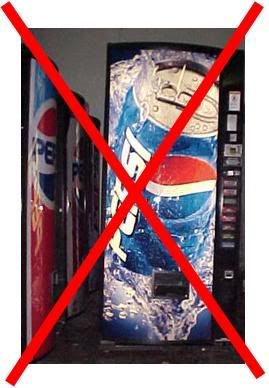
You won't see these in schools anymore.During my Wednesday morning commute, I came across this most unlikely headline in the Washington Post: "Sugary Drinks to be Pulled from Schools". The announcement that soda companies like Coca Cola, Pepsi, and Cadbury Schweppes are pulling their unhealthy wares from elementary, middle, and high schools was a huge surprise to me. After all, I recall that my high school had an exclusive contract with Pepsi. Our school was stocked with Pepsi vending machines and the scoreboard on the football field had a big Pepsi billboard. And the soda companies, which were raking in tons of money, didn't seem to be in a position where they needed to compromise.
(Interestingly enough, the University of Maryland also has a contract with Pepsi which prevents rival Coca Cola products from being sold in the diners. My roommate helpfully informs me that the McDonalds in our student union is one of only two locations worldwide to serve Pepsi products instead of Coca Cola, the fast-food chain's traditonal partner.)

Anyway, so the terms of this voluntary agreement appear pretty stringent:

The agreement calls for eliminating sales of sodas, diet sodas, sports drinks, juice drinks, apple juice or grape juice in elementary schools. Water and more healthful juices such as orange juice could continue to be sold, but in only eight-ounce or smaller containers, according to sources who were briefed yesterday. They spoke on condition of anonymity because the plan had not yet been announced.

In middle schools, the same drinks will be offered but in containers as large as 10 ounces.

In high schools, the drink size will be limited to 12 ounces. No sugary sodas will be sold, and half the drinks offered will be water or a low-calorie beverage, such as diet soda, diet lemonade or diet iced tea. Sports drinks will be allowed, as will juice drinks as long as they have fewer than 100 calories per serving.

It's about time. I remember seeing far too many kids in high school who needed a Mountain Dew just to get through the morning. These days, those kinds of unhealthy dietary habits are starting at an even younger age--just look at the childhood obesity rates. I wish that these sorts of measures were unnecessary, and that children were smarter about their eating decisions. But it's clear that at school and away from their parents, many kids just don't know how to make the right decisions.

I applaud this move by the beverage industry. Of course, the impact on their profits is negligible, they don't have to worry about brand recognition, and these companies can now push their juice and sports drink lines. They don't really have anything to lose. Now we'll have to see how kids react when they can't wash down their lunchtime feast of powdered donuts with a Code Red.

Monday, May 01, 2006

Not Business as Usual

(Click to enlarge.)
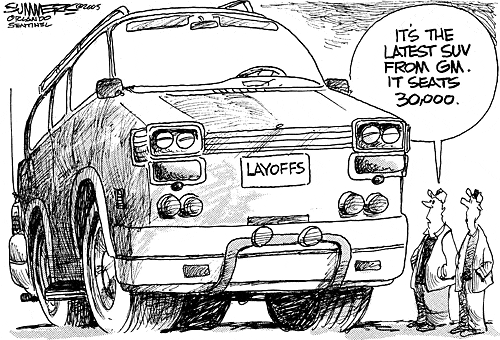
Bummed out by layoffs, corporate scandals, and outsourcing? Chin up, there's good news too. Readers of this blog will recognize a combination of ideas from a couple of previous posts last month in my newest Diamondback column, "Finish Your Homework". Here I acknowledge the threat of international competition in the "flat world" but point out why the U.S. needn't be too worried. Space restrictions required my magnum opus to be trimmed a bit, but I think it still gets the point across. An excerpt:
...several factors stand in the way of either China or India knocking the U.S. off its preeminent perch. Let us not forget the world’s most important and admired businesses today — companies such as Apple, Starbucks, Google, eBay and Goldman Sachs, to name a few — are distinctly American. I would tell my fellow Robert H. Smith School students it is probably unnecessary to bone up on Mandarin (though it couldn’t hurt) and we should not worry about spending our careers chasing after jobs in New Delhi or Shanghai. Nonetheless, one thing is clear: There are a lot of people on other continents out-hustling us Americans. While for now they might only represent a minority of their populations, more of them are springing up daily to take advantage of increased opportunities.
Click here to read the rest.