This post is a followup to Saturday's "Selling Out on F-16s"
Well folks, it may not have the allure of 50 Cent versus The Game, but there's beef afoot in the blogosphere!
This past weekend I was debating Mr. Adnan Gill of Owl's Tree, a journalist who "frequently writes articles in national and international news media." The latter raised a couple of points worth mentioning, but before I get to that I want to point to my readers to a post Mr. Gill subsequently made in which he resorted to ad hominem attacks implying that I was somehow disingenuous or less-than-forthcoming on this site about my identity.
I find the claim that I am hiding behind an Internet alias to be not only inaccurate, but humorous when considering that Mr. Gill got my email address from my profile on this site, where my full name and status as a student in Maryland is given. (An undergraduate at the University of Maryland, College Park for those who care to know.) While I am of Indian ethnicity, I was born and raised here to parents that are American citizens and have lived here for over twenty years. My pride in my heritage does not translate into a blind nationalism for a country that I do not really have any ties to. And I will be first in line to criticize India when their actions merit it, such as when religious strife is permitted or the rights of minorities are not protected. Had Mr. Gill chosen to question me on India's close ties to Iran as an energy source, I would admit that I find these actions in conflict with the U.S.'s attempt to isolate the "rogue state".
Mr. Gill, as he mentions on the home page of his site, is a political commentator whose work has been seen in many publications. In the interest of full disclosure, however, I think it is worth mentioning that he also happens to be a writer for the Pak Tribune, an Islamabad-based online news service. I believe it's only fair that this bit of information serve as a disclaimer to a site which posts entries with titles like "Come India, the myth is busted", "Indians behind masks" and "Indians, eat your hearts out!"
He said of me, "If I didn't know any better, I would say you are Indian." Whereupon I might speculate that he is from Pakistan or some other Muslim country. This point is actually irrelevant. Mr. Gill's affiliation does not detract from the value of his argument; it is, however, a reminder not to throw around claims of disingenuity or bias when they are unwarranted.
As to the actual matter at hand, I'll say this. India, situated in a dangerous "neighborhood", must have the means to protect itself. As a peaceful democracy, I would argue that it has earned that right. In my opinion, it is in the U.S.'s interest to promote India's economic expansion and military strength because they are a free country in South Asia whose growth as a world power is needed to balance the region. (An unstable dictatorship in Pakistan, India's other struggling small country neighbors, and the burgeoning power of communist China.) Nick commented on my previous post that Musharraf in charge of Pakistan is better than the fundamentalists, and with that I obviously agree. Still, we must not forget that democracy has intermittently existed in Pakistan in years past. With elements of democracy now coming to such unlikely places as Palestine, Ukraine, and Saudi Arabia, perhaps it's not too much to hope for a healthy democracy in Pakistan's future. That, I think, is the key to a lasting positive future for Indo-Pakistani relations.
I opposed the release of the F-16s to Pakistan because I do not want anything to escalate tensions between India and Pakistan right now. Recently, constructive measures have been taken to reduce hostilities, such as the creation of a bus line linking divided Kashmir. Why then, when such progress is being made, introduce a new point of contention into the equation?
All can agree, I think, that the one element of rivalry worth preserving between the two nations is in cricket. I understand that Pakistan apparently won a thrilling victory today--Mr. Gill, I surmise, should be pleased. As for me, I suppose it's a betrayal of my Indian roots that I've never seen a cricket match in my entire life--and the big sports event I'm eagerly awaiting is baseball's Opening Day! The only "mask" this Indian has ever put on is a catcher's mask.
The purpose of Citizens Band is not to provide political "spin" or to be a source of one-sided commentary. I try my best to adhere to the oft-quoted Daniel Patrick Moynihan maxim "everyone is entitled to his own opinion, but not his own facts." On that note, I thank Mr. Gill for providing an opposing perspective to my stated thoughts, and for prodding me to illustrate in greater detail my rationale for my position. These kinds of exchanges, I hope, are beneficial to both parties and to the readers of our blogs. The more said, the better, as long as what's being said is about the issue itself and not who is saying it.
Monday, March 28, 2005


Saturday, March 26, 2005
Selling Out on F-16s
The troubling news on Friday that the U.S. is finally agreeing to sell F-16 fighter jets to Pakistan caught everyone by surprise, and with good reason. Apparently, the reversal of a fifteen-year ban is a reward to Pakistan for being an ally in the war on terrorism. This is President Bush's way of "scratching the back" of Pakistan's autocratic ruler, Gen. Perves Musharraf, after being on the receiving end of favors in the past few years.
I strongly question Bush's decision for numerous reasons. The first would be to counter the principle rationale for this deal--that Pakistan has been very helpful in anti-terrorism operations after September 11, 2001. While this may be true, Bush is too easily discounting Pakistan's contributions to the other side. A.Q. Khan's nuclear proliferation network aided some of the worst enemies of our country--Iran, Iraq, Libya, and North Korea. Yet his actions, and their potentially serious consequences, have not factored it into Bush's assesment of Pakistan. Meanwhile, Pakistan continues to do nothing to rein in terrorists in its portion of the disputed region of Kashmir, leaving those groups unmolested and free to attack India.
Which raises my second argument against Bush's staunch support of Pakistan. Obviously, Pakistan's neighbor and rival, India, is displeased with the decision. The largest secular democracy in the world appears to be the Rodney Dangerfield of Asia in that it "don't get no respect." As my dad pointed out, it appeared earlier this week that this was finally about to change. Writing in the Wall Street Journal, former ambassador Robert Blackwill argued for "A New Deal for New Delhi", to recognize the "congruent vital national interests" of the U.S. and India. Blackwill readily proposed that Pakistan be sidelined.
On the same day, the New York Times featured an argument by former senator Larry Pressler entitled "Dissing Democracy in Asia". Pressler proved the need for a "fundamental policy shift" to a "robust pro-India stance" by constrasting, as Blackwill did, India's free, open, peaceful nature with Pakistan's opposite characteristics. Part of Bush's "expansion of freedom and liberty" should include choosing "free" India over "dictatorship" Pakistan, said Pressler. He even went so far as to suggest that the U.S. strengthen its alliance with India so as to offset a rising China, a move I heartily endorse.
The Bush administration announced that it is willing to sell lots of fighter planes to India as well, if India desires. Small comfort. Has he forgotten that India and Pakistan--nuclear powers, both--came to the brink of war in 2002? Having already sold out to Pakistan, the quick fix for the U.S. is to up the ante in India's favor. Yet the only real winner from all of this is Lockheed Martin. For the future, Bush would do well to choose his friends wisely, and always err on the side of freedom.
I strongly question Bush's decision for numerous reasons. The first would be to counter the principle rationale for this deal--that Pakistan has been very helpful in anti-terrorism operations after September 11, 2001. While this may be true, Bush is too easily discounting Pakistan's contributions to the other side. A.Q. Khan's nuclear proliferation network aided some of the worst enemies of our country--Iran, Iraq, Libya, and North Korea. Yet his actions, and their potentially serious consequences, have not factored it into Bush's assesment of Pakistan. Meanwhile, Pakistan continues to do nothing to rein in terrorists in its portion of the disputed region of Kashmir, leaving those groups unmolested and free to attack India.
Which raises my second argument against Bush's staunch support of Pakistan. Obviously, Pakistan's neighbor and rival, India, is displeased with the decision. The largest secular democracy in the world appears to be the Rodney Dangerfield of Asia in that it "don't get no respect." As my dad pointed out, it appeared earlier this week that this was finally about to change. Writing in the Wall Street Journal, former ambassador Robert Blackwill argued for "A New Deal for New Delhi", to recognize the "congruent vital national interests" of the U.S. and India. Blackwill readily proposed that Pakistan be sidelined.
On the same day, the New York Times featured an argument by former senator Larry Pressler entitled "Dissing Democracy in Asia". Pressler proved the need for a "fundamental policy shift" to a "robust pro-India stance" by constrasting, as Blackwill did, India's free, open, peaceful nature with Pakistan's opposite characteristics. Part of Bush's "expansion of freedom and liberty" should include choosing "free" India over "dictatorship" Pakistan, said Pressler. He even went so far as to suggest that the U.S. strengthen its alliance with India so as to offset a rising China, a move I heartily endorse.
The Bush administration announced that it is willing to sell lots of fighter planes to India as well, if India desires. Small comfort. Has he forgotten that India and Pakistan--nuclear powers, both--came to the brink of war in 2002? Having already sold out to Pakistan, the quick fix for the U.S. is to up the ante in India's favor. Yet the only real winner from all of this is Lockheed Martin. For the future, Bush would do well to choose his friends wisely, and always err on the side of freedom.
Monday, March 21, 2005
Terrorists' American Arsenal
A couple of high-profile news reports this month should have the Bush administration realizing that the fight against terrorism must be waged on the homefront as well. Two weeks ago the New York Times reported on a Congressional investigation which found that many suspected terrorists on federal watch lists were legally able to buy firearms in this country. Apparently, the lax gun laws in this country don't automatically prevent someone on one of those watch lists from purchasing a gun. Whose idea of homeland security is this?
Sunday's 60 Minutes feature story on gunrunner Florin Krasniqi further underscored how vulnerable our gun laws are to abuse. Krasniqi, who came into the country as an illegal immigrant, spent years smuggling .50-caliber rifles out of the country for use in his homeland of Albania. And he did it all with ease. Says Krasniqi, "Anything you need to run a small guerrilla army, you can buy here in America. You have all the guns you need here to fight a war. M-16s. That's what the U.S. soldiers carry in Iraq. All the rifles which U.S. soldiers use in every war, you can buy them in a gun store or a gun show."
Weapons that terrorists can use to kill lots of people are readily available to them here, and instead of preventing this from happening, we seem to be encouraging it. The NY Times article mentioned the "absurd policy" currently in place which destroys records of a terrorism suspect's gun purchase after 24 hours. Sen. Frank Lautenberg (D-NJ) has the right idea in wanting to store those records for at least ten years. If Republicans are serious about the war on terrorism, they will know to abandon their allegiance to the NRA on this issue and stop defending the "privacy rights" of terrorism suspects with regards to gun purchases. This is not a privacy issue, this is a national security issue.
I'd like to take it one step further. It seems to me that, after we've seen this huge problem exposed, the only proper course of action to take is to ban suspected terrorists from purchasing guns altogether. The loose restrictions we already have in place at least prevent felons from buying guns. Surely lawmakers on Capitol Hill can see the wisdom in denying sworn enemies of our country the means by which to harm us.
Sunday's 60 Minutes feature story on gunrunner Florin Krasniqi further underscored how vulnerable our gun laws are to abuse. Krasniqi, who came into the country as an illegal immigrant, spent years smuggling .50-caliber rifles out of the country for use in his homeland of Albania. And he did it all with ease. Says Krasniqi, "Anything you need to run a small guerrilla army, you can buy here in America. You have all the guns you need here to fight a war. M-16s. That's what the U.S. soldiers carry in Iraq. All the rifles which U.S. soldiers use in every war, you can buy them in a gun store or a gun show."
Weapons that terrorists can use to kill lots of people are readily available to them here, and instead of preventing this from happening, we seem to be encouraging it. The NY Times article mentioned the "absurd policy" currently in place which destroys records of a terrorism suspect's gun purchase after 24 hours. Sen. Frank Lautenberg (D-NJ) has the right idea in wanting to store those records for at least ten years. If Republicans are serious about the war on terrorism, they will know to abandon their allegiance to the NRA on this issue and stop defending the "privacy rights" of terrorism suspects with regards to gun purchases. This is not a privacy issue, this is a national security issue.
I'd like to take it one step further. It seems to me that, after we've seen this huge problem exposed, the only proper course of action to take is to ban suspected terrorists from purchasing guns altogether. The loose restrictions we already have in place at least prevent felons from buying guns. Surely lawmakers on Capitol Hill can see the wisdom in denying sworn enemies of our country the means by which to harm us.
Sunday, March 20, 2005
AFP Mistaken About Google News

The French news service Agence France Presse (AFP) is suing Google for indexing AFP in its popular Google News service. The AFP's cause for concern is that its subscription-only content is supposedly being provided free of charge by Google News.
Unfortunately, that statement is misleading. As a user of Google News for a couple years now, I have found it to be an invaluable resource. The site is my home page and I visit it more frequently than any other. Visitors to Google News know that the site simply indexes headlines from various news websites around the world and provides links to the full article on the respective organization's own website.
News organizations have the option of not being included in the Google News service, but virtually all of them do because the exposure is beneficial. I can attest that my reading habits have broadened after having read articles from publications I would not otherwise have the initiative or access to read. Certainly then, AFP is denying itself the opportunity to attract readers who would be interested in becoming subscribers based on the substantial content AFP offers.
Additionally, the AFP could very well solve their problem by following a model similar to others online publications that want to protect their content. Several organizations, including such prominent figures as the New York Times, the Washington Post, and the Los Angeles Times all require a user name and password to access a lot of their content. Or the AFP could go the route of Salon, and institute a pay-to-read system.
If the AFP really doesn't want in, they have that right and it appears Google has honored that. Personally though, I think the AFP is doing itself a disservice. Isn't the objective to get your content to as many readers as possible? Google News only helps direct readers to sites where they can get news. How those sites want to manager their own product is up to them, but it seems to me that AFP can come up with a better solution than the one they've got.
Saturday, March 19, 2005
Dude Looks Like a Lady
"Allah is not prejudiced. Are you?"
This past Friday, Muslims in the New York City area were shown an example of a more inclusive, tolerant faith when Dr. Amina Wadud, a woman, led a prayer service. By doing so, Dr. Wadud broke a long-standing Islamic tradition which dictates that only men may serve as imams (prayer leaders). Not only that, but there was no separation of men and women among the congregation, an Islamic tradition I had seen myself on a visit to a local Muslim prayer hall. Men and women prayed together at this event, which took place despite negative reaction from area mosques and even a bomb threat.
Not surprisingly, this incident has sparked a lot of controversy in the Muslim world. In the Middle East, some clerics have angrily denounced the practice while others have defended it. I noticed that on Al-Jazeera's English website, a largely negative report of the event was one of the most e-mailed stories.
The article did note, however, that in China women "routinely lead mixed Muslim congregations." So the practice is certainly not without precedent, and hopefully will receive more support from American Muslims. Here is as good a place as any to overturn a practice that is not even supported by the Koran.
Despite a lot of research on my part, I am thus far unable to find a reason why this practice has gone unchallenged for so long. If the matter were a central aspect of Islam, that would be a more difficult matter, but surely mainstream moderate Muslims don't believe that women are naught but distractions to men.
Searching the Internet for more reactions from Muslims, and coming across too many in the vein of this Morocco Times piece, I was heartened when I saw in an Arab News article the quote that led off this post. Those who are not fundamentalists, especially Muslims in this country, should ask themselves that question seriously. Change is overdue.
This past Friday, Muslims in the New York City area were shown an example of a more inclusive, tolerant faith when Dr. Amina Wadud, a woman, led a prayer service. By doing so, Dr. Wadud broke a long-standing Islamic tradition which dictates that only men may serve as imams (prayer leaders). Not only that, but there was no separation of men and women among the congregation, an Islamic tradition I had seen myself on a visit to a local Muslim prayer hall. Men and women prayed together at this event, which took place despite negative reaction from area mosques and even a bomb threat.
Not surprisingly, this incident has sparked a lot of controversy in the Muslim world. In the Middle East, some clerics have angrily denounced the practice while others have defended it. I noticed that on Al-Jazeera's English website, a largely negative report of the event was one of the most e-mailed stories.
The article did note, however, that in China women "routinely lead mixed Muslim congregations." So the practice is certainly not without precedent, and hopefully will receive more support from American Muslims. Here is as good a place as any to overturn a practice that is not even supported by the Koran.
Despite a lot of research on my part, I am thus far unable to find a reason why this practice has gone unchallenged for so long. If the matter were a central aspect of Islam, that would be a more difficult matter, but surely mainstream moderate Muslims don't believe that women are naught but distractions to men.
Searching the Internet for more reactions from Muslims, and coming across too many in the vein of this Morocco Times piece, I was heartened when I saw in an Arab News article the quote that led off this post. Those who are not fundamentalists, especially Muslims in this country, should ask themselves that question seriously. Change is overdue.
Sunday, March 13, 2005
Middle School in a Maelstrom
In Sunday's Washington Post, columnist Marc Fisher took to task my alma mater Takoma Park Middle School for its supposedly exclusionary program of rewarding high-performing students with a chance to spend a week studying in Florida. I immediately wrote to Fisher and the Post editorial board to set the record straight:
Even after acknowledging that the school has gone to great lengths to make the trip include as many students as possible, and that cost is not prohibitive--thanks to donations, the school offers aid to those who can't afford the trip--Fisher seems intent on railing at the straw man of racism or elitism or who knows what. I wish he hadn't done so merely for the purpose of filling a column.
But the Florida Trip isn't the only reason Takoma Park MS has been in the crossfire recently. A Post article earlier in the week reported that a group of African-American parents are pushing for the school's magnet program to be shut down or radically altered (see: "Parents Protest Magnet Makeup"). Their complaints are based on the fact that a fewer percentage of African-American student applicants are accepted than white or Asian applicants. That said, the article does not mention that those students rejected from the program do not meet the requirements (i.e.: grades, test scores, activities) for entry into the program.
If I were in the position of those angry parents, I would not focus my energies on trying to close the magnet program or establish affirmative action in middle schools. The real problem here lies with the preparation of minority students in grade school for standardized testing and other barometers of academic performance. Those parents should demand that the county work to prepare all students--not just white and Asian students--for academic success. Then let Takoma Park's selection process do its job of finding the most gifted and promising students in the county.
I have twice participated in Takoma Park Middle School's yearly trip to Florida, once as a student, and again last year as a high school chaperone. Thus it is with grave concern that I read Marc Fisher's assault ("A Class Trip Into a Land of Questions," Mar. 13) on what is one of the best experiences the school offers its students.
Mr. Fisher seeks to characterize the program as one designed to shut out some kids while rewarding others. Nothing could be further from the truth. As he mentioned, the trip is open to all eighth-graders with good academic standing. This is no concerted effort to deny minorities or non-magnet students from going on the trip. On the contrary, this policy serves as incentive for all students to get good grades so that they can go to Florida with their friends. Rather than a symbol of oppression, the trip is actually motivation to many students to work hard in school.
When I first went on the trip in 2000, I shared a room with two African-American friends of mine. They were not magnet students; I was. Contrary to Mr. Fisher's claims, there was never the slightest hint of tension between magnet and non-magnet students. In fact, the trip had the opposite effect, bringing everyone closer together. I remember having many conversations about girls, sports, and Disney World--and none about racial or economic exclusion. We were just kids, out to have a good time while learning in a very non-traditional setting.
In light of the criticism that Mr. Fisher mentions the Florida trip has come under recently, it is my fervent hope that the program's value is not forgotten. It would be a real shame to no longer offer deserving students at Takoma Park this remarkable opportunity.
Even after acknowledging that the school has gone to great lengths to make the trip include as many students as possible, and that cost is not prohibitive--thanks to donations, the school offers aid to those who can't afford the trip--Fisher seems intent on railing at the straw man of racism or elitism or who knows what. I wish he hadn't done so merely for the purpose of filling a column.
But the Florida Trip isn't the only reason Takoma Park MS has been in the crossfire recently. A Post article earlier in the week reported that a group of African-American parents are pushing for the school's magnet program to be shut down or radically altered (see: "Parents Protest Magnet Makeup"). Their complaints are based on the fact that a fewer percentage of African-American student applicants are accepted than white or Asian applicants. That said, the article does not mention that those students rejected from the program do not meet the requirements (i.e.: grades, test scores, activities) for entry into the program.
If I were in the position of those angry parents, I would not focus my energies on trying to close the magnet program or establish affirmative action in middle schools. The real problem here lies with the preparation of minority students in grade school for standardized testing and other barometers of academic performance. Those parents should demand that the county work to prepare all students--not just white and Asian students--for academic success. Then let Takoma Park's selection process do its job of finding the most gifted and promising students in the county.
Monday, March 07, 2005
Cosmetic Changes Make the New SAT

Sunday's Outlook section of the Washington Post contained the must-read article "New SAT? We Know the Score" by Patrick Welsh.
I'm a freshman at the University of Maryland now, so these changes come too late to affect me. But having been through the gauntlet before, I've been following with interest the attempt to revise a sacrosanct part of the college admissions process. Initially, I welcomed the idea of updating what seems to everyone an old-fashioned test that wasn't really successful at guaging academic ability. Welsh refered to University of California President Richard Atkinson's 2001 speech recommending that his school system drop the SAT as an admission requirement. That suggestion drew shockwaves--but Atkinson was right on when he described the "overemphasis of the SAT".
The SAT is a test designed to measure instrinsic aptitude and thus is supposedly a good predictor of a student's ability to succeed in college. But really, most high school juniors and seniors can tell you that success on the SAT is directly related to test-taking skills, not academic ability. This isn't an assertion coming from someone embittered by their experience--I offer my own SAT experience as an example.
In my junior year of high school, I took the test with a minimal level of preparation, figuring that I had a high level of ability in English and Math. I came out with a score of 1460, a very impressive performance by any standard, but actually among the lower-end range of students in my hyper-competitive high school. I took the test again the next year, and without the aid of any new math or English classes relevant to the test, I improved my score to 1560. This time around though, I prepared by becoming intimately familiar with the test and its structure, through the aid of the uber-helpful "10 Real SATs" and other practice tests on CD. Anyone can experience significant improvement in their SAT score thru mindless, repetitve preparation. It's no small wonder that the Kaplan and Princeton Review and Co. all make a fortune off of their test preparation courses, which can be a big benefit to those who can afford their steep cost.
That said, I was hoping the new SAT would bring the change Mr. Atkinson said was "long overdue". But like Mr. Welsh, I'm not impressed with the largely cosmetic changes that have been made. The famous analogy questions were removed to transform the "Verbal" section into "Critical Reading" only. Quantitative comparison questions were eliminated from the Math section and Algebra II material was added. The biggest change however, is the addition of a "Writing" section to the test, a 25-minute essay followed by multiple choice questions on grammar and syntax. If this sounds exactly like the existing SAT II: Writing test, you're right. It appears the College Board has pretty much appended that test to make the SAT even more bloated.
I'm not quite sure what is the purpose of adding the writing section to the SAT. In the past, colleges that wanted to look at that aspect of a student's ability would require the SAT II writing test--but Welsh points out that it is hardly a universal requirement. Had I been around late enough to take the new SAT, I'm guessing from my 800 score on the SAT:II Writing that I would probably have benefited from the changes. But I still feel it's a bad idea, namely because it introduces too arbitrary an element into the equation.
"By increasing the size of his handwriting, Luo was able to stretch a one-page essay into a two-page essay, creating the impression of a student with plenty to say. He also made sure to sprinkle his draft with such words as "equivocal" and "esoteric," conveying the sense of a sophisticated vocabulary."
The grading system as Welsh described is atrocious, especially prone to subjectivity. The writing section has always been hit or miss, especially with regards to the topics assigned. While I was writing this post, my roommate recalled his experience having to write an essay comparing "style vs. substance". I've had friends with even more frustrating stories.
But my biggest complaint, personally, is that the format of the essay in the new section is yet another encroachment of the cookie-cutter writing standard that is already too prevalent in public education. Think five paragraphs (intro, three body, conclusion). Body paragraphs must have topic sentence in predictable location. Clearly defined thesis, stated in the first paragraph, restated in last paragraph. If on the surface that sounds like teaching kids good writing, believe me, it's not. Years of suffering through my county's rigid adherence to the formula for writing essays--or "Extended Constructed Responses" as the school board's technocrats had us call them--showed me how woefully ineffective the technique was at teaching good writing.
It's hard for students to show creative thought when they're hamstrung by the rigid mentality that grades them--emphasizing adherence to a standardized grading rubric (easier for teachers to grade) rather than a focus on content and strength of argument. Now it seems that the very practice I decried during my years in secondary education have received a seal of approval from the ultimate authority of the College Board. Might as well codify their approach into law, because which teacher is going to teach otherwise when the SAT asks differently? None, unfortunately, and the result will be telling.
Still, despite everything, I know it won't be long before everyone gets used to the new SAT, and life (or at least the college admissions process) returns to normal. I never thought that the old SAT was fundamentally flawed, just that it had its weaknesses. The SAT has long been a useful standardized method of evaluating students--the only problem is that its results have become too overvalued. I was hoping to see greater reform than was taken by the College Board in producing the new version of the exam. but nonetheless I can't imagine a future without it. So while there may be no more "sanguine:optimism :: tenacious:persistence", teen angst, parental pressure, and prep books remain very much a part of the new SAT!
Thursday, March 03, 2005
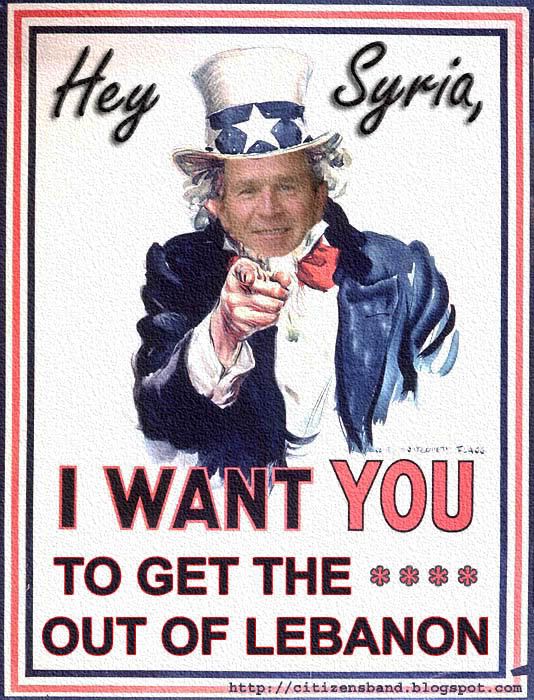
Serious About Syria
"You get your troops and your secret services out of Lebanon so that good democracy has a chance to flourish."
-- President Bush (on Wednesday)
The Prez means business! OK, so he sounded more like a frazzled soccer mom scolding her kids for misbehaving in the minivan, but the point still stands. It turns out that the latest fad to hit the Middle East is--no, not John Mayer, though I wish we could get rid of him somehow--scaling back on repression. Elections in Saudi Arabia (however meaningless), the promise of elections in Egypt (Hosni, you know how to tease us), and now the resignation of the pro-Syrian puppet goverment in Lebanon. Wow, the only way this scene could be more riveting is the sudden discovery that the late Prime Minister Hariri was assasinated not in a bombing but by dioxin poisoning! Then we'd have ourselves a bona fide feel good story.
Folks, in a few months time we'll see jubilant Lebanese dancing in the streets, holding up purple-stained fingers in celebration of their vote. This momentous triumph of freedom will--ok, ok, slow down. I guess the feel-good moment is getting to me. Still, I'm interested in seeing what happens next. I always get this excited when I see freedomon the march bravely limping forward.
Who's going to come out on top in this one--Assad, Hezbollah, or Good Democracy? There's almost enough possible outcomes to start a "March Madness" bracket! Root for your favorite from the comfort of your own home. If you're a true fan of freedom, you'll hang this on your bedroom wall:
 (Click to enlarge.)
-- President Bush (on Wednesday)
The Prez means business! OK, so he sounded more like a frazzled soccer mom scolding her kids for misbehaving in the minivan, but the point still stands. It turns out that the latest fad to hit the Middle East is--no, not John Mayer, though I wish we could get rid of him somehow--scaling back on repression. Elections in Saudi Arabia (however meaningless), the promise of elections in Egypt (Hosni, you know how to tease us), and now the resignation of the pro-Syrian puppet goverment in Lebanon. Wow, the only way this scene could be more riveting is the sudden discovery that the late Prime Minister Hariri was assasinated not in a bombing but by dioxin poisoning! Then we'd have ourselves a bona fide feel good story.
Folks, in a few months time we'll see jubilant Lebanese dancing in the streets, holding up purple-stained fingers in celebration of their vote. This momentous triumph of freedom will--ok, ok, slow down. I guess the feel-good moment is getting to me. Still, I'm interested in seeing what happens next. I always get this excited when I see freedom
Who's going to come out on top in this one--Assad, Hezbollah, or Good Democracy? There's almost enough possible outcomes to start a "March Madness" bracket! Root for your favorite from the comfort of your own home. If you're a true fan of freedom, you'll hang this on your bedroom wall:
 (Click to enlarge.)
Tuesday, March 01, 2005
Juvenile Death Penalty, R.I.P.
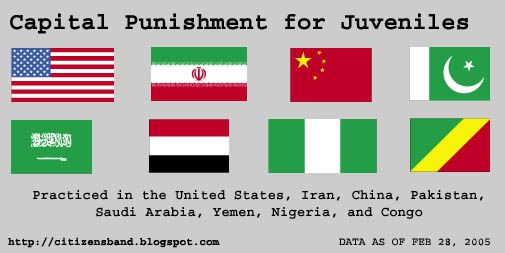
Well, I guess we won't be needing this graphic anymore:
 (Click to enlarge.)
"Supreme Court Forbids, 5-4, Execution in Juvenile Crime"
- Justice Anthony Kennedy (author of majority opinion):
Apparently the wiser heads on the bench took their cues from "evolving standards" and the prevailing international sentiment. Terrible controversy? No, not in this case, because I'm more comfortable with the U.S. being in line with "the rest of the world" as opposed to "Iran, China, & Co."
 (Click to enlarge.)
"Supreme Court Forbids, 5-4, Execution in Juvenile Crime"
- Justice Anthony Kennedy (author of majority opinion):
"It is fair to say that the United States now stands alone in a world that has turned its face against the juvenile death penalty."- Justice Antonin Scalia (dissenting opinion):
"I do not believe that the meaning of our Eighth Amendment, any more than the meaning of other provisions of our Constitution, should be determined by the subjective views of five members of this court and like-minded foreigners."- Justice Sandra Day O'Connor (dissenting opinion):
"This nation's evolving understanding of human dignity certainly is neither wholly isolated from, nor inherently at odds with, the values prevailing in other countries."
Apparently the wiser heads on the bench took their cues from "evolving standards" and the prevailing international sentiment. Terrible controversy? No, not in this case, because I'm more comfortable with the U.S. being in line with "the rest of the world" as opposed to "Iran, China, & Co."
Ask Sistani
If you're in the mood for a little late night humor, click on over to the website of Iraq's supreme religious authority, the Grand Ayatollah Ali al-Sistani. The most enjoyable reading comes from the "Q&A" section, which appears to be an advice column published by the Ayatollah based on questions written to him. (Think "Dear Abby" with some Shi'a 'tude.) There, you can find out about the types of problems that ordinary Iraqis write to him about. The ever-helpful Sistani is ready to dispense invaluable bits of advice, including the following:

Enjoy! Hat tip to Bill Maher.
- playing chess is "absolutely forbidden"
- shaking hands with girls is "not permissible"
- listening to music for fun is unlawful
- plastic surgey is OK
- ditto for polygamy
Enjoy! Hat tip to Bill Maher.
Subscribe to:
Posts (Atom)